
REVIEW · WALKING TOURS
Liverpool: Heritage, History & Culture Guided Walking Tour
Liverpool’s past comes with plenty of plot twists. This two-hour walk links the city’s maritime power, slave-trade legacy, grand waterfront buildings, and Beatles landmarks in one well-paced introduction. I especially like the mix of famous sights and less obvious stories, plus the chance to hear Liverpool explained by local guides such as Mike, Allan, Pam, and Karl.
At $31 per person, it offers solid value if you want orientation before exploring alone. The main consideration is the walking surface: busy streets, cobbles, and a group pace can make this less comfortable for anyone with limited mobility, despite the stated wheelchair-accessible route.
In This Review
- Key things to know before you book
- Starting at the Bluecoat in Liverpool city center
- Liverpool’s early story and Liverpool One
- Derby Square and the memory of Liverpool Castle
- The first dry dock and Liverpool’s maritime past
- Royal Albert Dock and the Titanic connection
- The Beatles Statue and Liverpool’s musical identity
- The Three Graces and Liverpool’s grand waterfront
- Exchange Flags and the Town Hall
- Mathew Street, the Cavern Quarter, and The Beatles
- Finishing near Eleanor Rigby
- What the guides do well
- Price, pace, and practical value
- Who should book this Liverpool walking tour?
- Should you book it?
- FAQ
- How long is the Liverpool Heritage, History & Culture walking tour?
- Where does the tour begin?
- Where does the tour finish?
- Is the tour conducted in English?
- Are food and drinks included?
- What should I wear or bring?
- Can I bring a dog?
- Is the tour suitable for wheelchair users?
Key things to know before you book
- Liverpool’s story goes beyond The Beatles: You’ll hear about King John, the port, the slave trade, civic power, and the city’s changing fortunes.
- The waterfront is the visual highlight: The Royal Albert Dock and Three Graces provide the tour’s best architecture and photo stops.
- Mathew Street brings the music history: The Cavern Quarter connects the modern city with The Beatles and generations of musicians.
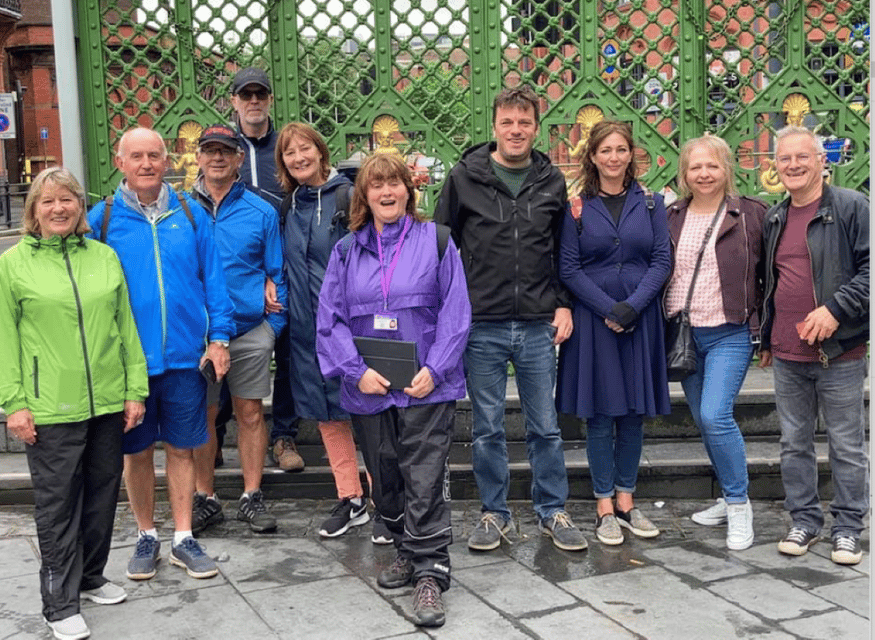
- Local guides make the difference: Mike, Mike D, Allan, Pam, Carl, and Karl have been praised for clear explanations, humor, patience, and personal love of the city.
- It is an overview, not an in-depth museum visit: You see and discuss many places, but you do not spend extended time inside attractions.
- The route finishes near the Eleanor Rigby Statue: That makes it easy to continue exploring the Cavern Quarter and city center afterward.
Starting at the Bluecoat in Liverpool city center
The tour begins outside the front gates of the Bluecoat Chambers at 8 School Lane. Look for the main entrance with black metal railings, and use the Castle Fine Art gallery-shop opposite as a visual marker. The What3Words location is Soccer Trial Cuts.
This is a sensible starting point. The Bluecoat places you in the center of Liverpool’s shopping and civic district, close to Liverpool One and within easy reach of the waterfront. The building itself is also a useful reminder that Liverpool is not just docks and pop music. Its historic presence gives the walk an early cultural marker before you move through the modern city.
You do not need to arrive expecting a formal check-in desk. The departure point is outside the gates. The Bluecoat Chambers building opens from 10am Tuesday through Saturday, and it has a café and toilets inside, but those facilities may not be available before opening or on every tour departure.
Wear comfortable shoes and bring water. You will cover a lot of ground in two hours, often through busy central streets, and some sections have uneven cobbles. A camera is worthwhile, especially at the waterfront and around the Beatles statues.
More History Tours in Liverpool
- Liverpool: Haunted History Guided City Tour
★ 4.9 · 404 reviews - Liverpool: A Walk Through Time: Full History Walking Tour
★ 4.8 · 184 reviews - Liverpool: St James’ Cemetery Historical Ghost Tour
★ 4.9 · 169 reviews
Liverpool’s early story and Liverpool One
The opening section sets out how Liverpool developed from its medieval beginnings to its modern role as a major English city. Stories reach back to the time of King John, then move through the growth of the port and the changes that shaped the city center.
You begin to see why a guide helps here. Liverpool can look like a collection of handsome buildings, shopping streets, docks, and music venues until someone explains how those parts connect. A good guide turns the walk into a timeline, showing how trade, shipping, politics, and culture altered the city.
The route passes through Liverpool One, the large modern retail and leisure district. This is not the oldest part of the city, but it helps show how Liverpool has reused and rebuilt its center. The contrast between modern development and older civic buildings is part of the point.
Guides have been praised for explaining changes in the city’s ground levels and physical development, not just reciting dates. That kind of detail can make the streets easier to read as you continue. You may also find this early section more conversational than theatrical, with time to ask questions about people and events that shaped Liverpool.
Derby Square and the memory of Liverpool Castle
Derby Square introduces one of the city’s more easily missed stories: Liverpool Castle once occupied this area. The castle is gone, but its place in the city’s past remains part of the street plan and local memory.
Today, the square is marked by an imposing monument to Queen Victoria. The guide uses this setting to explain how Liverpool’s center changed and how buildings and monuments can replace earlier layers of the city. It is a good example of the tour’s approach: you are not simply taken to famous landmarks, you are encouraged to picture what occupied the same space before.
This section may appeal most to people who enjoy urban history. There is no castle to enter and no large surviving ruin to inspect, so the story depends on the guide’s explanation. The reward is understanding what you are not seeing.
The first dry dock and Liverpool’s maritime past
One of the tour’s useful stops is connected with Liverpool’s first dry dock. A large water fountain marks the area and provides a physical link to the city’s maritime development.
Liverpool’s port shaped its wealth, population, buildings, and place in international trade. The walk does not present that story as a simple tale of commercial success. It also addresses Liverpool’s role in the slave trade, an essential part of understanding how the city grew and where some of its wealth came from.
That subject is difficult, but leaving it out would give you a false picture. A short walking tour cannot explain every detail, yet it can point you toward the questions and places worth exploring more deeply afterward. The guides have been praised for offering an honest and balanced introduction rather than treating Liverpool’s past as a string of feel-good anecdotes.
Nearby, you’ll see the oversized LIVERPOOL sign. Its colors change with the season or special events, making it an easy photo stop. It is a modern, playful feature beside older maritime references, and it gives the group a quick break from the heavier historical material.
More Walking Tours in Liverpool
- Liverpool: Beatles Highlights Walking Tour
★ 4.8 · 274 reviews - Liverpool: The Beatles and Cavern Quarter Walking Tour
★ 4.7 · 133 reviews - Liverpool: Guided City Walking Tour
★ 4.9 · 119 reviews - Liverpool: The Beatles and Waterfront Guided Walking Tour
★ 4.7 · 51 reviews
Royal Albert Dock and the Titanic connection
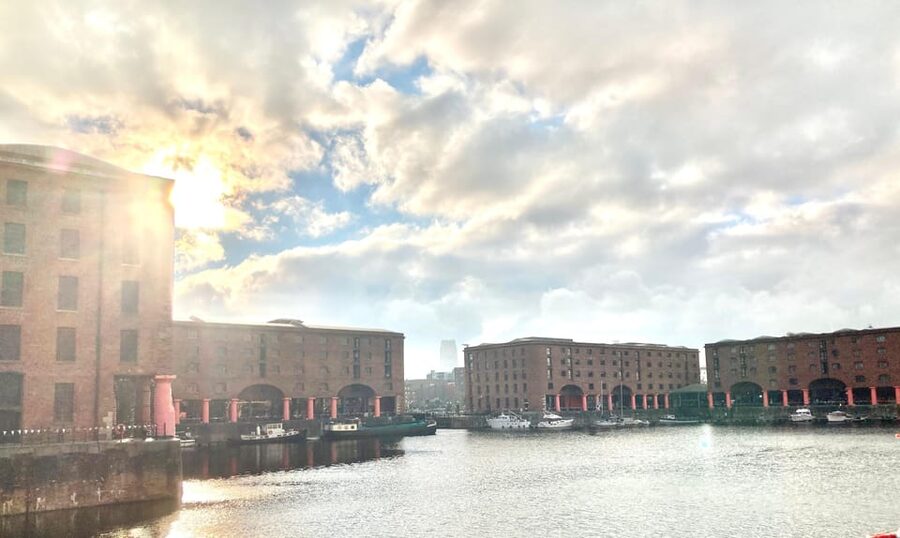
The Royal Albert Dock is the longest stop, at about 30 minutes, and it is likely to be the visual center of your walk. The converted dock buildings, open water, warehouses, and broad views make this an easy place to understand Liverpool’s connection with shipping and trade.
The guide explains how the docks helped the city grow and how their later reuse gave the waterfront a new role. You’ll also hear how the Titanic story became part of Liverpool’s maritime identity. Liverpool was closely connected with the ship’s history through the White Star Line, and the story remains woven into the city’s port narrative.
The dock is a strong photo location, but the real value is the context. Without explanation, the handsome warehouses can seem like a polished waterfront quarter. With the guide’s help, you get a clearer sense of the work, commerce, and engineering that once filled this area.
The route includes sightseeing and a photo stop rather than an extended visit inside a museum. If you want detailed Titanic exhibits or a close study of dock operations, plan separate time after the walk. The tour gives you the setting and the story, then keeps moving.
The Beatles Statue and Liverpool’s musical identity
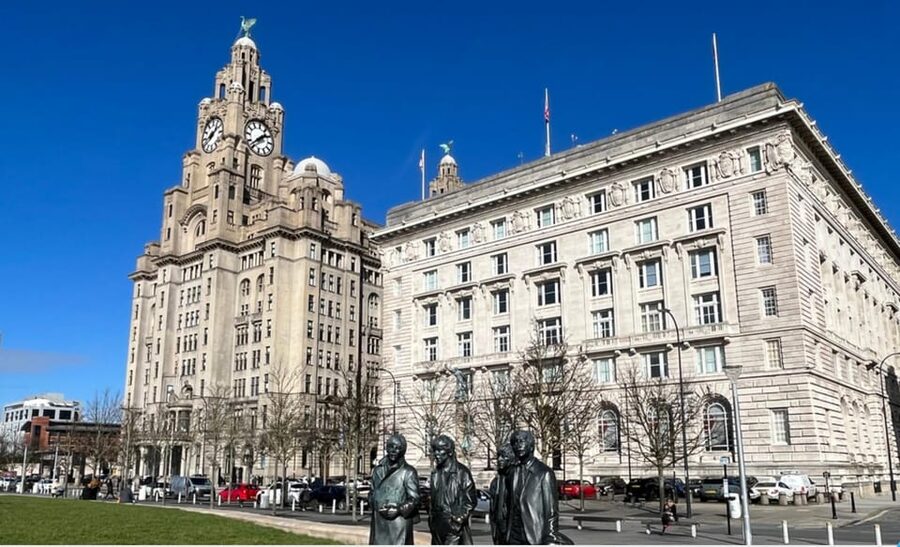
The Beatles Statue provides one of the tour’s most obvious photo opportunities. It was sculpted by Andrew Edwards and gives you a chance to pose with the Fab Four near the waterfront.
The statue is more than a simple celebrity stop. It shows how strongly Liverpool connects its public identity with music, and it lets the guide place The Beatles within the wider story of the city. The tour later develops that subject further in Mathew Street and the Cavern Quarter.
Allow about 10 minutes here. That is enough for photographs and a short explanation, but not enough for a full Beatles history lesson. If you are a serious fan, treat this as an introduction and use the guide’s suggestions to decide what to visit afterward.
The Beatles connection is handled alongside architecture, shipping, and social history. That balance is useful because it keeps the walk from becoming a narrow music tour. You get the famous names, but also a sense of the city that produced and celebrated them.
The Three Graces and Liverpool’s grand waterfront
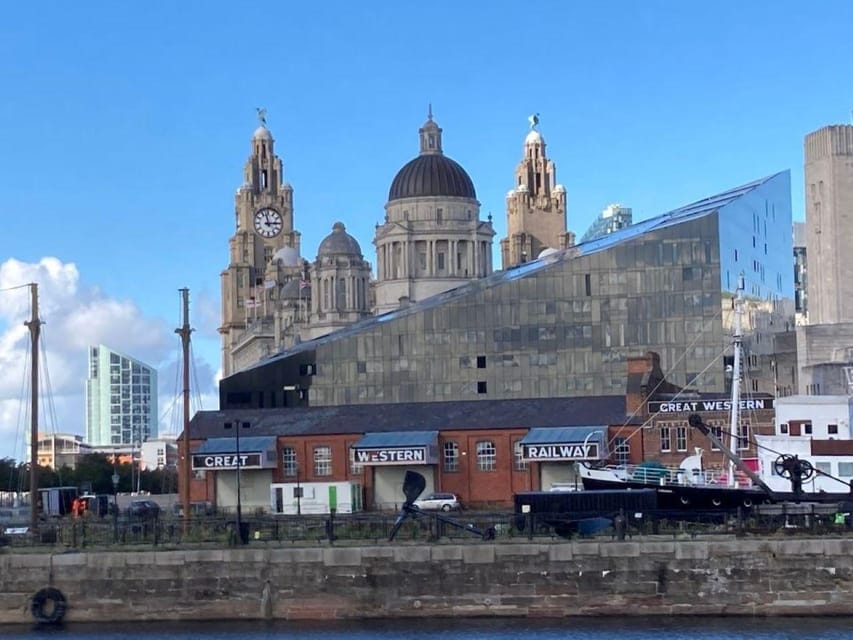
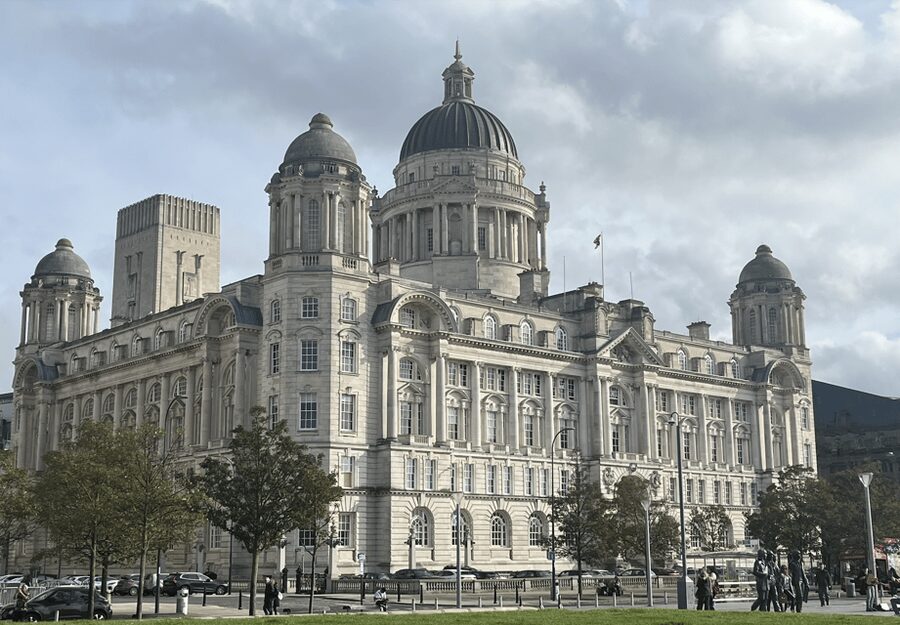
The Three Graces are the architectural centerpiece of the waterfront. They are the Cunard Building, the Port of Liverpool Building, and the Liver Building, grouped together along the river.
The Cunard Building and Port of Liverpool Building are Grade II listed. The Liver Building is the instantly recognizable landmark with its Liver Birds. From outside, you can appreciate the scale and ambition of the waterfront without needing to enter each building.
This is where the tour’s architecture explanations pay off. The buildings are not just attractive backdrops. They reflect Liverpool’s commercial power, maritime connections, and civic pride. Your guide can point out how the three structures work together visually and why this stretch became such a strong symbol of the city.
The 15-minute stop gives you time to look up, take photographs, and hear the basic story. I would not expect a detailed architectural lecture in that time, but the explanation should help you notice more than the outline of the buildings.
Exchange Flags and the Town Hall
Exchange Flags forms a formal courtyard facing Liverpool Town Hall. Its Grade II listed buildings create a sharp change from the open waterfront and the livelier shopping streets.
The area gives the guide another chance to explain Liverpool’s civic and commercial power. The Town Hall is currently Grade I listed and is recognized as one of England’s finest surviving 18th-century town halls. You’ll also hear about earlier town halls dating back to the 1500s, which adds a longer civic timeline to the walk.
This stop is especially useful if you enjoy seeing how public buildings express a city’s confidence. Liverpool’s grand architecture was built to announce that the city mattered, and the guide helps you read that message.
The tour focuses on the exterior. If you want to see the inside of the Town Hall, confirm opening arrangements separately and allow extra time beyond the walk.
Mathew Street, the Cavern Quarter, and The Beatles
Mathew Street is the noisiest and most music-focused part of the route. It is closely linked with the Cavern Club and The Beatles, and the guide places you in the footsteps of musicians who made Liverpool famous around the world.
The Cavern Club itself is a major reference point, but the area’s importance goes beyond one venue. Mathew Street became synonymous with Liverpool’s music scene, and the walk uses it to explain how local performance spaces helped shape the city’s cultural reputation.
Expect around 20 minutes in the Cavern Quarter. That allows time for photographs and stories, though it does not include food, drinks, or a dedicated club visit. You may want to return later if you would like to spend more time in the area.
This section can be particularly enjoyable if you know little about The Beatles. It gives you a physical sense of place instead of presenting the band as a collection of names and album covers. If you already know the Beatles story well, the guide’s local anecdotes and broader Liverpool context may be more valuable than the basic facts.
Finishing near Eleanor Rigby
The walk ends at the Eleanor Rigby Statue. This is a fitting final point after the Beatles Statue and Cavern Quarter, and it leaves you in a useful part of the center for further sightseeing.
By the end, you will have seen major waterfront architecture, central streets, music landmarks, civic buildings, and places tied to Liverpool’s port. You will not have explored each one in depth, but you’ll have a clear map of where to return.
That orientation is one of the tour’s strongest benefits. Several people who took the walk with Mike, Mike D, Allan, Pam, Carl, or Karl found that it revealed parts of Liverpool they had previously missed. The best guides also adjust their explanations to questions, so do not hesitate to ask about a building, local figure, or historical period that catches your attention.
What the guides do well
The guide is central to the quality of this experience. The strongest feedback focuses on clear voices, enthusiasm, patience, humor, and the ability to connect facts to the people who lived through them.
Mike and Mike D are praised for passion, wit, and detailed answers. Allan is described as friendly, engaging, and professional. Pam is credited with a good mix of facts, opinion, humor, and personal stories, while Karl is praised for his love of Liverpool and for including unusual places and anecdotes.
That range matters because the exact tone may vary by departure. Some guides may give you a tightly paced city overview. Others may allow more conversation or continue beyond the planned two hours when the group is engaged.
The walk seems best suited to people who enjoy listening and asking questions. It is not a silent photo circuit. You’ll get more from it if you pay attention to the links between stops and let the guide explain why Liverpool developed as it did.
Price, pace, and practical value
At $31 per person, the tour is reasonably priced for a two-hour guided introduction in central Liverpool. You are paying for a local guide, a planned route, and interpretation of places that would otherwise be easy to pass without understanding.
The value is strongest during a first visit. You can use the walk to decide where to return, perhaps spending more time at the Royal Albert Dock, the Cavern Quarter, the Town Hall, or a museum connected with Liverpool’s maritime past.
The price is less attractive if you want long interior visits, food, drinks, or a specialist Beatles-only experience. None of those are included. The tour is also not private, although the size of individual groups is not specified. One reported departure had a single participant, while other descriptions suggest a normal group setting, so the feel may vary.
Free cancellation up to 24 hours before the start and the option to reserve now and pay later make it easier to fit into a changing schedule. Starting times vary, so check availability before planning other activities around it.
The route is described as easy walking, but busy areas and cobbles deserve attention. The information says locations are accessible for strollers and wheelchairs, while also marking the activity as unsuitable for people with mobility impairments and wheelchair users. That is a clear inconsistency. If you use a wheelchair or have difficulty with uneven ground, contact the provider before booking and ask about the exact route and group pace.
Well-behaved dogs are welcome, but busy streets and a moving group may not suit every dog. Bring water and expect to remain outdoors for most of the experience.
Who should book this Liverpool walking tour?
I would choose this tour for a first visit, a short city break, or a morning when you want to get your bearings before exploring independently. It is also a good fit if you want Liverpool’s port, civic buildings, difficult past, and music culture presented together.
Families with older children may appreciate the short stops and strong visual landmarks. Beatles fans will enjoy the statue, Mathew Street, the Cavern Quarter, and Eleanor Rigby, while history-focused visitors will get useful context about the docks, slavery, the castle site, and the Town Hall.
I would be more cautious if you need a fully step-free route, dislike walking on cobbles, or want to spend most of your time inside attractions. The tour moves through busy public areas, and two hours leaves little room for extended stops.
Should you book it?
Book this Liverpool walking tour if you want a lively, local introduction rather than a narrow Beatles tour or a museum visit. The strongest reason to go is the guide: Mike, Allan, Pam, Karl, and the other local hosts bring warmth, humor, and personal detail to a route that covers a surprising amount in two hours.
Skip it if you already know central Liverpool well and prefer slow, independent sightseeing. For most first-time visitors, though, $31 buys a useful city framework, several excellent photo stops, and enough historical background to make the rest of your Liverpool visit more meaningful.
FAQ
How long is the Liverpool Heritage, History & Culture walking tour?
The tour lasts two hours. The listed stops include sightseeing periods of about 10 to 30 minutes, with the longest stop at the Royal Albert Dock.
Where does the tour begin?
It begins outside the front gates of Bluecoat Chambers at 8 School Lane, Liverpool L1 3BX. Look for the black metal railings and the Castle Fine Art gallery-shop opposite.
Where does the tour finish?
The tour finishes at the Eleanor Rigby Statue.
Is the tour conducted in English?
Yes. A live local guide leads the tour in English.
Are food and drinks included?
No. Food and drinks are not included. You should bring water, and the Bluecoat Chambers building has a café when it is open.
What should I wear or bring?
Wear comfortable shoes because the tour involves walking through central streets and across some uneven cobbled surfaces. A camera and water are also recommended.
Can I bring a dog?
Well-behaved dogs are welcome. Keep in mind that the route passes through busy areas and continues as part of a walking group.
Is the tour suitable for wheelchair users?
The information describes the locations as accessible for strollers and wheelchairs, but it also lists the activity as unsuitable for people with mobility impairments and wheelchair users. Because the route includes busy areas and uneven cobbles, contact the provider before booking to confirm whether the current route meets your needs.
Just added in Liverpool
- Soulful Sunday Roast Dinner with Drag Queens★ 4.6 · 3 reviews
- Liverpool: Private City Highlights Walking Tour★ 5.0 · 4 reviews
- Private City Tour – Liverpool★ 5.0 · 1 review
- From Liverpool: North Wales Sightseeing Tour Shore Excursion★ 4.3 · 34 reviews
- Liverpool: Beatles-Themed Private Taxi Tour with Transfers★ 5.0 · 113 reviews
- Liverpool: Wild West Saloon Immersive Cocktail Experience★ 5.0 · 2 reviews
- Liverpool: The Beatles Tour on Electric Pedal-Assist Ebikes★ 5.0 · 17 reviews
- Liverpool: 1980s Music Walking Tour with Guitarist “Nasher”★ 5.0 · 6 reviews
Walking Tours, compared.

Magical London: Harry Potter Guided Walking Tour
Read our review →

University and City Walking Tour with Alumni Guide
Read our review →
Harry Potter Movies Walking Tour (Kids Go Free)
Read our review →
The Great British Rock and Roll Music Walking Tour
Read our review →
Jack the Ripper Walking Tour – Ripper Vision Tours
Read our review →
Other lists this tour turns up in