
REVIEW · WALKING TOURS
Bristol: Air Raid Shelter & St. Nicholas Market Walking Tour
Bristol keeps a wartime secret underground. This tour pairs Old City stories with access to the city’s large public WW2 air raid shelter, then finishes at St Nicholas Market, where you can buy lunch. I like the unusual mix of 1,000 years of trade, Blitz damage, and 1960s music history. The main drawback is that the shelter remains a developing attraction, with limited museum space and uneven preservation.
You meet at the main entrance of the Corn Exchange, a central and easy-to-find starting point. Guides such as Owen, Duncan, and Theresa have earned praise for lively storytelling and strong subject knowledge. I also like that the tour costs only $16, though you should allow anywhere from 75 minutes to two hours and bring comfortable shoes.
In This Review
- Key things to know before you book
- Starting at the Corn Exchange and going below Bristol
- The Old City walk and Bristol’s trading past
- Entering Bristol’s large public air raid shelter
- A small museum with room to grow
- Finishing at St Nicholas Market
- Why the guides matter so much
- Timing, price, and practical value
- Who should book this Bristol tour?
- Should you book the Air Raid Shelter and St Nicholas Market tour?
- FAQ
- Where does the tour start?
- Where does the tour finish?
- How long does the experience last?
- What is included in the price?
- Is food included?
- What language is the tour conducted in?
- What should I bring?
- Who is the tour not suitable for?
Key things to know before you book
- The shelter is the star attraction: You go below the Corn Exchange into a preserved WW2 air raid shelter that is usually closed to the public.
- The walk puts the war into context: You see Blitz damage and important Old City buildings before entering the shelter.
- The Corn Exchange has a musical past: Some rooms once hosted major 1960s bands, including the Rolling Stones.
- St Nicholas Market makes a useful finale: Food and souvenirs are available after the guided portion, but you pay for them separately.
- The guides make the difference: Owen, Duncan, and Theresa are praised for clear delivery, humor, passion, and vivid wartime stories.
- The setting is not suitable for everyone: Narrow underground areas, stairs, and the shelter environment rule out people with mobility impairments or claustrophobia.
Starting at the Corn Exchange and going below Bristol
The meeting point is the main entrance of the Corn Exchange. This is more than a place to gather. The building itself forms part of the story, with exclusive areas included in the tour and rooms linked to Bristol’s music scene in the 1960s.
The promise of seeing spaces connected with bands such as the Rolling Stones adds a welcome twist. This is not only a war tour. Bristol’s trading past, architecture, popular music, and wartime survival all share the same walk.
Your guide leads you through the Old City rather than sending you straight underground. That is important because the shelter makes more sense once you have seen the streets above it.
The route covers ancient streets, notable buildings, and parts of Bristol affected by German bombing raids. The Temple Church, Wine Street, and Corn Street receive particular attention, along with the damage caused during the Blitz.
I like this approach because it gives the shelter a human setting. You are not simply looking at an old underground room. You are connecting it with the streets where people worked, shopped, traded, and tried to carry on during the war.
The guides use stories rather than only dates and facts. Owen is praised for speaking clearly and keeping groups engaged, while Duncan is known for bringing the wartime period to life with humor and enthusiasm. Theresa has also been praised for making the stories feel immediate.
More Walking Tours in Bristol:
- Bristol: Blackbeard to Banksy Guided Walking Tour
★ 4.9 · 1,422 reviews - Magical London: Harry Potter Guided Walking Tour
★ 4.7 · 22,044 reviews - London: The Original Jack the Ripper Walking Tour
★ 4.7 · 7,833 reviews
The Old City walk and Bristol’s trading past
The first part of the experience reaches back well before the Second World War. Bristol’s position as a trading city shaped the streets around the Corn Exchange and St Nicholas Market, and the guide links the city’s older commercial life with its modern market culture.
You will not get a full academic course in Bristol’s past during a short walking tour. Instead, you get a brisk introduction to the city’s development, with the war placed inside a much longer story.
That balance works well for a first visit. If you already know Bristol, it can still surprise you. Several long-time residents have discovered facts about streets they thought they knew, especially details about the bombing raids and the shelters beneath the city.
The walk also lets you look carefully at the architecture. The buildings are not just scenery between stops. Their former uses and wartime damage help explain why this part of Bristol matters.
The pace is designed to keep the group moving toward the shelter. You should expect regular stops for explanation, but this is not a slow architectural sketching tour. If you want long periods to photograph every building, you may find the schedule a little tight.
Entering Bristol’s large public air raid shelter
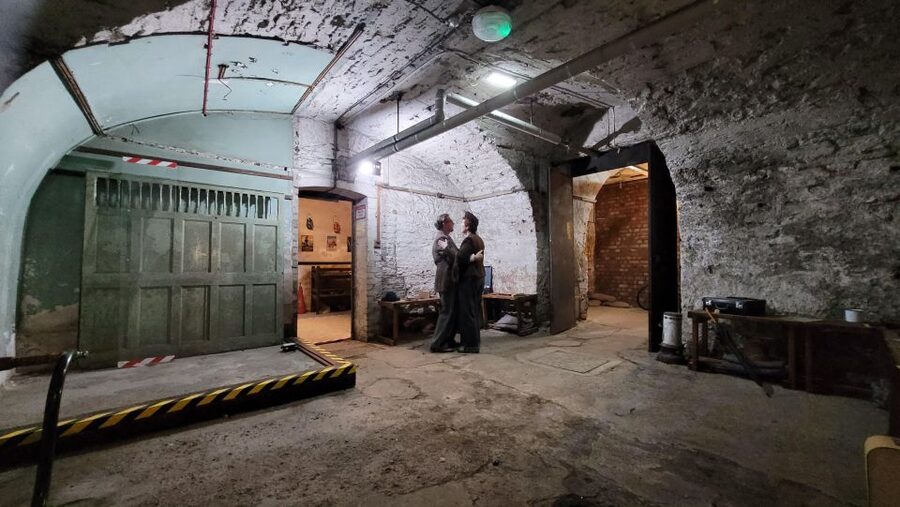
The underground shelter is the reason to choose this experience over a standard city walk. It remains largely untouched, and its plain, functional condition is part of its power.
You see the physical conditions in which Bristol residents sheltered during the Second World War. The atmosphere comes from the rooms themselves, not from a large exhibition built around them.
That authenticity has a trade-off. The shelter is not presented as a polished museum with extensive displays in every room. Some areas need renovation, and the museum section is still being developed.
I see that as both a weakness and a strength. If you want bright galleries, neat labels, and a large collection of objects, this will feel modest. If you prefer a site that still shows its age, the rough edges make the visit more affecting.
The guide supplies much of the interpretation. Owen and Duncan are particularly praised for explaining what life in the shelter may have been like and for showing wartime objects. Their enthusiasm keeps the underground section from becoming a silent walk through empty rooms.
You may also hear about Margaret, the shelter’s friendly ghost. Treat that as a playful part of the tour rather than a reason to book a paranormal experience. The main value is the wartime site and the stories attached to it.
The shelter can feel enclosed, so think carefully about your comfort before booking. The experience is specifically unsuitable for people with claustrophobia, and it is not suitable for people with mobility impairments. The supplied information also excludes people over 300 pounds, or 136 kilograms, and people over 95 years old.
A small museum with room to grow
At the end of the underground visit, you may have time to look at wartime articles and artefacts. This is where the tour’s unfinished quality becomes most apparent.
There appears to be more material than the current museum space can display comfortably. Some people would like extra time to read the items and ask questions, so do not expect a long self-guided museum visit after the main talk.
The project has clear room to grow. More funding could improve the shelter, expand the display area, and explain features such as the former entrance more clearly. The fact that these improvements are still needed should be part of your buying decision.
Still, I would not dismiss the site because it lacks polish. The limited presentation is balanced by direct access to a place that is normally unavailable. You are supporting a small historical project while seeing a part of Bristol that is easy to miss from street level.
If preservation matters to you, this is a worthwhile reason to book. The shelter’s future has been a concern, and the tour helps keep attention on its value as an educational site.
More Shopping Tours in Bristol:
- Bristol: Old Market Self-Guided Craft Beer Tour
★ 4.6 · 11 reviews - Secrets of London Bike Tour: Thames, Tower Bridge & Market
★ 4.8 · 42 reviews - London: Camden Market Guided Walking Food Tour
★ 4.8 · 15 reviews - London: Bicester Village Shopping Day Trip with Coach Ride
★ 3.8 · 8 reviews
Finishing at St Nicholas Market
The tour ends at St Nicholas Market, with drop-off options listed at both St Nicholas Market and the Corn Exchange. The market gives the experience a more relaxed finish after the serious wartime section.
You can buy sweet and savory food, street-food meals, and small souvenirs. Food and drink are not included in the $16 price, so bring extra money if you want to eat.
This final stop is useful because it lets you continue exploring at your own pace. You can turn the tour into a short history-and-food outing without arranging another activity across town.
The market also connects neatly with the tour’s opening themes. You begin with Bristol’s trading past and finish in a working market where food and goods are still exchanged. That link gives the route a clear shape rather than making the market feel like an unrelated drop-off point.
Do not expect the guide to provide a full food tour. The market is available for your own sampling after the guided section. If you want a particular lunch, check the stalls for yourself and budget separately.
Why the guides matter so much
The shelter has genuine atmosphere, but the guide carries much of the experience. A weak presentation would leave you looking at bare rooms. A strong one helps you picture families waiting through raids, understand the damage above ground, and connect Bristol’s wartime story with its older streets.
The most praised guides are Owen and Duncan, with Theresa also receiving warm recognition. Owen is described as enthusiastic, clear, and entertaining. Duncan brings a strong personal commitment to the project and has ideas for expanding the attraction. Theresa is praised for turning the stories into something lively and easy to follow.
The costumed presentation adds color without changing the basic subject. You are still receiving a guided history walk, but the WW2 costume helps set the period and gives the tour a sense of occasion.
The style should suit families and mixed-age groups, provided everyone can manage the walking and underground conditions. Humor is used alongside serious material, so the tour does not become a grim list of bombing dates.
I would choose this tour for the guide-led storytelling rather than for a large collection of physical exhibits. The people leading it are doing much of the work that a bigger museum might normally handle through displays, films, and interactive panels.
Timing, price, and practical value
The advertised duration ranges from 75 minutes to two hours. The guided sections are listed as 85 minutes in the Old City and 110 minutes at St Nicholas Market, but those figures do not line up neatly with the shorter overall duration. In practice, you should keep a two-hour window free, while understanding that some departures may take closer to an hour and a quarter.
That flexibility matters if you are planning lunch, a train, or another timed attraction. Book it when you can allow breathing room afterward.
At $16 per person, the price is strong for a guided Old City walk plus entry to a normally restricted wartime site and exclusive Corn Exchange areas. You also receive a useful introduction to St Nicholas Market without paying for a separate market tour.
The value is especially good if you enjoy local history, overlooked buildings, and guide-led interpretation. It is less compelling if your main goal is a large museum collection, a long food tasting, or a fully accessible walking route.
Comfortable shoes are essential. You will walk through old streets and enter an underground shelter, so leave unsuitable footwear at home.
The tour is in English and uses a live guide. If you do not follow spoken English comfortably, the storytelling element may be difficult to appreciate.
Free cancellation is available up to 24 hours before the tour for a full refund. You can also reserve now and pay later, which helps if your Bristol plans are still changing.
Who should book this Bristol tour?
I would recommend it to first-time visitors who want something beyond the usual city landmarks. It gives you a compact orientation to the Old City, then adds a genuinely unusual site beneath the streets.
It also suits Bristol residents. The repeated surprise among local attendees is understandable because the shelter is easy to overlook, even when you are shopping at St Nicholas Market or walking near the Corn Exchange.
History fans will get the most from the Blitz accounts and shelter visit. Architecture fans will enjoy the Old City setting, while music fans have an extra reason to pay attention to the Corn Exchange rooms associated with 1960s bands.
Families can consider it if older children are comfortable with wartime subjects and enclosed spaces. The guide-led format and humor help keep it accessible, but the subject is still serious and the physical setting is not suitable for everyone.
I would skip it if you need step-free access, dislike enclosed rooms, or want plenty of time to read museum displays. You may also prefer another activity if your schedule cannot spare up to two hours.
Should you book the Air Raid Shelter and St Nicholas Market tour?
Book it if you want an unusual Bristol experience at a modest price. The preserved shelter, Blitz-damaged streets, Corn Exchange stories, and market finish make a thoughtful combination.
Go in expecting a developing historical attraction, not a finished museum. The limited display space and need for preservation are real drawbacks, but they also explain why the tour feels personal rather than packaged.
For most visitors who can manage the walking and underground setting, I think the $16 fee is easy to justify. Choose a departure that leaves time afterward for food at St Nicholas Market, wear comfortable shoes, and let the guide’s stories do the heavy lifting.
FAQ
Where does the tour start?
The tour starts at the main entrance of the Corn Exchange.
Where does the tour finish?
The listed drop-off locations are St Nicholas Market and the Corn Exchange.
How long does the experience last?
The stated duration ranges from 75 minutes to two hours. You should allow up to two hours when planning your day.
What is included in the price?
The price includes the guided tour, entry to the WW2 air raid shelter, and entry to exclusive areas of the Corn Exchange.
Is food included?
No. Food and drinks are not included, but you can buy them at St Nicholas Market.
What language is the tour conducted in?
The live tour guide speaks English.
What should I bring?
Bring comfortable shoes for the Old City walk and the underground portion.
Who is the tour not suitable for?
The experience is not suitable for people with mobility impairments, claustrophobia, people over 300 pounds or 136 kilograms, or people over 95 years old.
More Markets in Bristol
- Borough Market Food Tour
★ 5.0 · 5 reviews - London: Borough Market Food Tour with Local Guide
★ 4.8 · 4 reviews - Borough Market London Bridge & Fish & Chips
★ 5.0 · 2 reviews
Just added in Bristol
- St Mary Redcliffe Church Bristol: Guided Tour★ 4.7 · 67 reviews
- From Bristol: 4-Day Cornwall, Devon & Stonehenge Tour★ 4.3 · 22 reviews
- Bristol: Wake The Tiger Amazement Park Entry Ticket★ 4.3 · 156 reviews
- Bristol: Bristol Zoo Project Entry Ticket★ 4.3 · 18 reviews
- Bristol: Venomous Snake Tour w/ Guide & Croc Photo★ 5.0 · 1 review
- Bristol: The Best Of Bristol, Guided Bike Tour★ 4.8 · 68 reviews
- Bristol : Sightseeing Custom Tour with a Local Guide★ 3.9 · 6 reviews
- Bristol: The House Magicians Comedy and Magic Show★ 4.7 · 37 reviews
Walking Tours, compared.

Magical London: Harry Potter Guided Walking Tour
Read our review →

University and City Walking Tour with Alumni Guide
Read our review →
Harry Potter Movies Walking Tour (Kids Go Free)
Read our review →
The Great British Rock and Roll Music Walking Tour
Read our review →
Jack the Ripper Walking Tour – Ripper Vision Tours
Read our review →
Other lists this tour turns up in