
REVIEW · CITY TOURS
Durham Full City Tour
Durham reveals itself one story at a time. This 2.5-hour walking tour links the city’s grand landmarks with its stranger tales, from powerful Prince Bishops and medieval battles to prison escapes, ghosts, and the odd piece of divisive modern architecture. You meet at the Man on the Horse statue in the Market Place, then follow a route through bridges, riverbanks, the university quarter, and the UNESCO World Heritage Site.
I like the way the tour combines big Durham views with small local details you could easily miss alone. I also like the guide’s personal connection to the city. Peter, who has led tours here for four years, receives especially warm praise for making complex history simple, lively, and fun. The main drawback is the route itself: cobbles, steps, and small hills make this a poor fit for anyone who needs a fully step-free walk.
In This Review
- Key points to know before you book
- Starting in Durham Market Place
- Framwellgate Bridge and Durham’s Prince Bishops
- Riverside paths and the view from Prebends Bridge
- South Bailey, the city wall, and university life
- Kingsgate and Durham Crown Court
- Elvet Bridge and Durham’s ghostly side
- Palace Green and the final approach to the Cathedral
- What the $35 price gives you
- Practical details and who should book
- Should you book the Durham Full City Tour?
- FAQ
- Where does the Durham Full City Tour meet?
- How long does the tour last?
- What language is the tour conducted in?
- Does the tour enter Durham Cathedral or Durham Castle?
- Which main places are included?
- Is the route suitable for wheelchair users?
- Can I cancel for a full refund?
Key points to know before you book
- The route covers Durham’s main historic core: You see the Market Place, Framwellgate Bridge, Prebends Bridge, South Bailey, Kingsgate, Durham Crown Court, Elvet Bridge, Palace Green, and the Cathedral exterior.
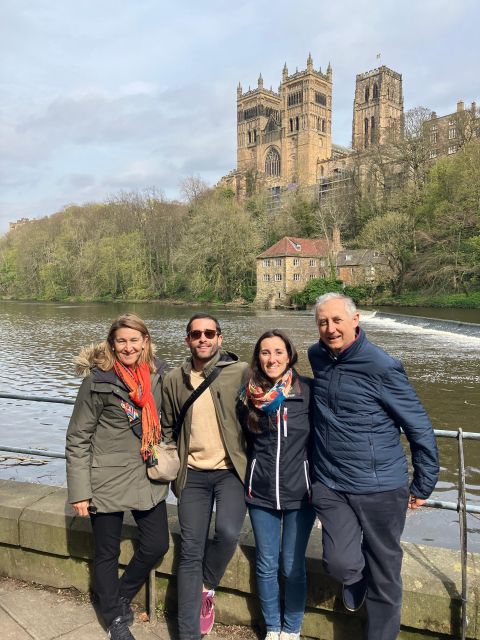
- Framwellgate Bridge gives you a classic Durham view: The oldest bridge in the city looks toward Durham Castle and Cathedral.
- The stories range well beyond royal and religious history: Expect tales of Scots, prisoners, executions, legends, tragedies, miracles, and even a gruesome story behind Kingsgate.
- This is a walking tour, not an interior tour: You do not enter Durham Cathedral, Durham Castle, the prison, or any other building.
- The guide is a major strength: Peter and the other guides bring local recommendations, contemporary observations, and plenty of detail about Durham’s past.
- The route takes about two and a half hours: That gives the guide time to explain the city properly, but you should wear sensible shoes and allow for uneven ground.
Starting in Durham Market Place
The tour begins in the middle of the historic Market Place, beside the Man on the Horse statue. Look for the black Walkabout Durham umbrella. This is a practical meeting point because you are already in the city center, surrounded by several of the buildings that set up Durham’s story.
The Market Place is more than a place to gather. You see the 19th-century Town Hall and Guildhall, St. Nicolas’ Church, and statues linked to important people from the city and county. Your guide uses these sights to explain who shaped Durham and how civic, religious, and political power worked here.
This opening section helps you get your bearings before the walking begins in earnest. Instead of rushing straight to the cathedral, you start with the city’s public face: local government, worship, trade, and memorials. I find that a useful approach because Durham can feel like a compact jumble of steep streets and old stone. A guide gives those pieces an order.
The early stories also set the tone. This is not simply a parade of famous buildings. You learn about people and events, including some less polished episodes in Durham’s past. That makes the city feel lived-in rather than frozen in medieval stone.
A few more options to weigh up in Britain
- Liverpool: City & Beatles Tour with Live Guide & Live Music
★ 4.8 · 5,249 reviews - Oxford: University and City Walking Tour with Alumni Guide
★ 4.7 · 4,429 reviews - Etihad Stadium: The Manchester City Stadium Tour
★ 4.8 · 3,096 reviews
Framwellgate Bridge and Durham’s Prince Bishops
From the Market Place, you walk a short distance to Framwellgate Bridge. It is the oldest of Durham’s bridges and one of the best places to pause for a view of the castle and cathedral.
This is where the tour turns toward the city’s most famous power structure: the Prince Bishops. Durham’s bishops were not only religious leaders. They held unusual political authority, and their role helps explain why the castle and cathedral occupy such a commanding position above the river.
You get the history while looking at the buildings themselves, which is far better than hearing a list of dates in a room. The bridge also gives you a sense of Durham’s physical character. The river bends around the historic center, while the cathedral and castle rise above it. The setting explains much about the city’s past, including its defensive value and its strong religious identity.
The guide’s job here is to connect the view with the people who used it. The castle and cathedral are impressive from a distance, but the stories of the Prince Bishops give them political weight. You begin to understand that Durham was not just a provincial town with two fine buildings. It was a place where church and state power met.
Riverside paths and the view from Prebends Bridge
From Framwellgate Bridge, the route follows a picturesque riverside walk toward Prebends Bridge. This section takes about five minutes, so you get a short change of pace after the first history stop.
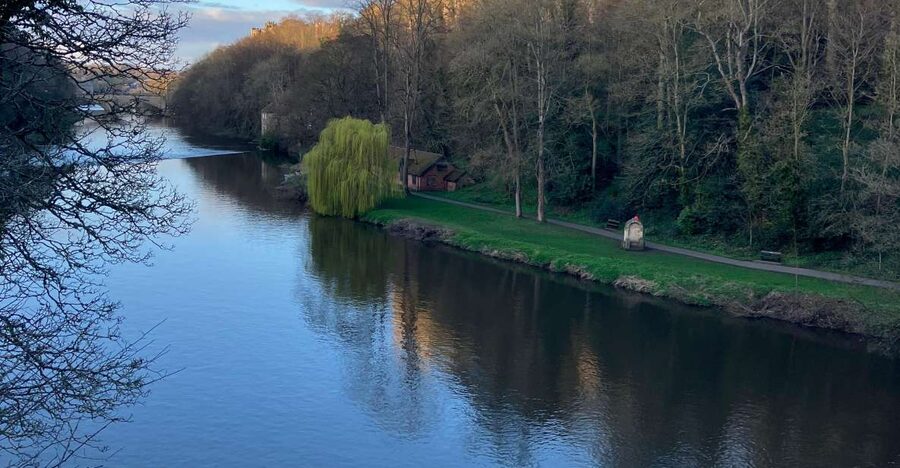
Along the riverbanks, the guide points out the city’s mills and explains how the river shaped Durham’s working life. That detail matters. The cathedral and castle often dominate photographs, but the river also supported industry and daily labor. Looking at the banks with that in mind gives you a more complete sense of the city.
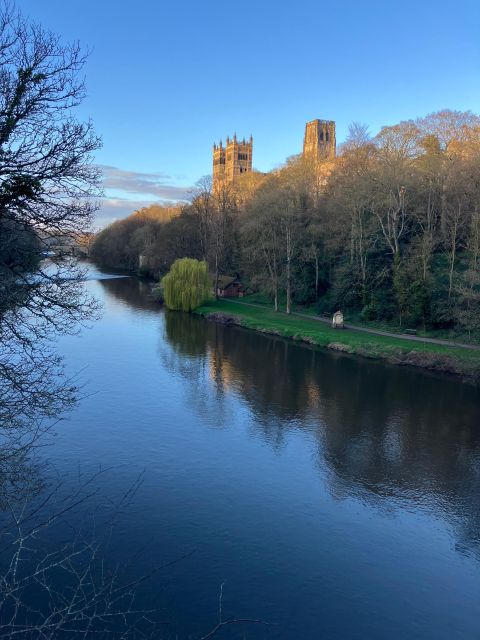
Prebends Bridge is another excellent viewpoint, with striking views of Durham Cathedral. If you want photographs, this is one of the key stops. The setting is particularly useful because you see the cathedral in relation to the river, trees, bridges, and rising ground instead of only from the front.
I like this part because it gives the tour some breathing room. You are still learning, but you are not standing in a busy square. You walk beside the water, take in the scenery, and hear about the less grand side of Durham’s past. The route is short, though the uneven ground and small slopes are worth keeping in mind.
South Bailey, the city wall, and university life
The walk continues toward South Bailey, passing sections of the medieval city wall. Here the tour explores Durham’s historic rivalry with the Scots, adding a military and border dimension to the story.
The city wall is not just a leftover piece of masonry. It helps you picture Durham as a defended medieval settlement, with access, movement, and political tension shaped by its position in northern England. The guide uses the wall to explain conflict rather than asking you to admire it without context.
South Bailey is now closely linked with Durham University. The university quarter adds another layer to the city, since modern student life occupies streets and buildings with medieval roots. That contrast is one of the pleasures of the route. You move through a working part of the city, yet the old walls and architecture keep the earlier story close.
St. Mary the Less is a particularly interesting stop. Now affiliated with St. John’s College, the church has connections with Durham legends. The guide explains those stories while drawing attention to the building’s architecture. This is the sort of detail you might miss if you simply walked through the Bailey on your way to the cathedral.
You should not expect a formal university tour or access to the college interiors. The value here comes from the setting, the exterior details, and the stories attached to them.
A different kind of day out entirely:
- London: The London Eye Entry Ticket
★ 4.6 · 35,875 reviews - From London: Harry Potter Warner Bros Studio Tour
★ 4.7 · 26,588 reviews - London: Westminster to Greenwich River Thames Cruise
★ 4.5 · 22,836 reviews - Magical London: Harry Potter Guided Walking Tour
★ 4.7 · 22,044 reviews
Kingsgate and Durham Crown Court
At Kingsgate, the tour takes a darker turn. You hear the gruesome story behind the site’s name, then consider some controversial 20th-century architecture nearby.
That combination is very Durham: medieval legend beside modern buildings that have divided opinion. The stop is not only about old stone. It also shows that the city continues to change, and that not every addition receives universal affection. If you enjoy architecture, this is a useful reminder that Durham is not a museum set untouched in time.
The next stop is Durham Crown Court, connected with the city’s 200-year-old prison. Here the subject becomes crime and punishment. You hear about infamous prisoners, how they exercised, how some escaped, and how executions took place.
This is one of the strongest sections for anyone who likes social history. A cathedral can tell you about faith and power, but a prison reveals how authorities treated ordinary people, criminals, and those accused of crimes. The stories also add variety to the tour. You are not simply moving from one grand building to another.
The subject matter may be too grim for some children or for anyone hoping for a purely scenic city walk. The tour does not hide the harsher parts of Durham’s past, so keep that in mind when choosing it for your group.
Elvet Bridge and Durham’s ghostly side
At historic Elvet Bridge, the guide shares tragic tales connected with people who once lived in or passed through the city. Some are still believed to remain in spirit.
This is where Durham’s legends become part of the experience. The ghost stories are not a separate theatrical performance. They sit alongside the city’s real streets, bridges, and buildings, giving familiar places an eerie second meaning.
I appreciate this kind of storytelling when it is tied to a specific location. You are not hearing a generic haunted-house tale. You are standing at a bridge with its own past, and the story helps you look at it differently. The balance between documented history, local legend, and darker folklore keeps the walk entertaining.
The tour’s tone appears to remain friendly rather than sensational. Guides such as Peter are praised for being approachable and for explaining complicated subjects in simple language. That matters on a long walking tour. A guide who can tell a grim story without losing the human detail makes the experience easier to follow.
Palace Green and the final approach to the Cathedral

The last major section takes you onto Palace Green, the heart of Durham’s UNESCO World Heritage Site. This is the grand payoff of the route, with the cathedral and castle gathered around one of the city’s most important open spaces.
Here the guide draws together the themes introduced earlier: battles, tragedies, miracles, religious belief, and political authority. Palace Green works well as a final stop because the buildings around it are not just impressive façades. They represent the forces that shaped Durham for centuries.
The tour finishes at the doors of Durham Cathedral. This is a useful place to end because you can continue your own visit afterward, if opening arrangements suit your plans. Remember, the guided tour does not enter the cathedral. The same applies to the other buildings along the route.
For me, that exterior-only format is both a limitation and a benefit. You do not get interior access as part of the $35 price, so anyone wanting a guided visit inside the cathedral or castle will need to arrange that separately. On the other hand, the tour stays focused on the city as a whole. You see how the cathedral relates to bridges, walls, rivers, courts, churches, and streets rather than spending the full time inside one monument.
What the $35 price gives you
At $35 per person, this is not the cheapest way to spend two and a half hours in Durham, since you can walk through much of the city without paying. The value comes from the explanation and the route design.
Without a guide, you might find the Market Place, cross a bridge, photograph the cathedral, and wander through the Bailey. You would be much less likely to connect the Prince Bishops with the castle, the river with the mills, the wall with Scottish rivalry, or the prison with the city’s criminal past.
The tour also saves you from working out a sensible route through Durham’s hills and bridges. You get major views, unusual stories, and local context in one outing. Several people who joined the tour praised the guide’s recommendations about Durham’s present-day development as well as its past, which adds value if you are staying longer than a single afternoon.
The price makes the most sense for a first visit, for anyone short on time, or for you if you prefer history explained on the spot rather than read from plaques. It is less essential if you already know Durham very well or only want to enter the cathedral.
Practical details and who should book
The tour is conducted in English by a live local guide. You meet at the Man on the Horse statue in the center of the Market Place, with the black Walkabout Durham umbrella as your marker.
Wear shoes suited to cobbles, steps, and small hills. The route is not suitable for wheelchair access because of these surfaces and changes in level. You should also expect to be on your feet for much of the two and a half hours, with stops for stories and views.
I would choose this tour early in a Durham visit. It gives you a useful map of the historic center and points out places you may want to revisit on your own. The final stop at the cathedral is especially convenient if you want to continue sightseeing after the guide says goodbye.
The booking terms are flexible: you can reserve now and pay later, and cancellation is free up to 24 hours before the tour for a full refund. That is useful if your wider UK itinerary depends on weather or changing plans.
The strongest reason to book is the guide. Peter is repeatedly praised for his warmth, clear explanations, passion, and broad knowledge of both historic events and current local development. One particularly useful quality is his ability to point out odd details and places you would probably miss without help.
Should you book the Durham Full City Tour?
You should book it if you want a well-rounded introduction to Durham rather than a single monument visit. The route gives you classic cathedral views, local legends, political history, prison stories, university connections, and a look at the river and city walls.
It is also a good choice for you if you enjoy a guide who makes history approachable rather than academic. The consistently high rating of 4.8 from nine verified bookings reflects strong praise for friendly, clear, and entertaining guiding.
Skip it if you need a completely accessible route, dislike uneven walking, or only want to go inside Durham Cathedral. For most first-time visitors who can manage the terrain, though, $35 buys a useful sense of how Durham fits together, not just a collection of attractive photographs.
FAQ
Where does the Durham Full City Tour meet?
Meet at the Man on the Horse statue in the middle of Durham Market Place. Look for the black Walkabout Durham umbrella.
How long does the tour last?
The guided walking tour lasts approximately 2.5 hours.
What language is the tour conducted in?
The tour is conducted in English with a live English-speaking guide.
Does the tour enter Durham Cathedral or Durham Castle?
No. The tour is an outdoor walking tour and does not enter any buildings. It finishes at the doors of Durham Cathedral.
Which main places are included?
The route includes Market Place, Framwellgate Bridge, the riverside walk, Prebends Bridge, South Bailey, St. Mary the Less, Kingsgate, Durham Crown Court, Elvet Bridge, Palace Green, and the exterior of Durham Cathedral.
Is the route suitable for wheelchair users?
The route is not suitable for wheelchair access because it includes steps, cobbles, small hills, and other uneven terrain.
Can I cancel for a full refund?
Yes. You can cancel up to 24 hours in advance for a full refund. You can also reserve your place and pay later.
Just added in Britain
- Chester: The Dead Good Ghost Walking Tour★ 4.3 · 9 reviews
- London: Live Comedy Show at Big Belly Bar and Comedy Club★ 4.5 · 80 reviews
- London: British Museum Highlights Guided Small Group Tour★ 4.9 · 113 reviews
- The Best of British Cooking Class & Dining Experience★ 5.0 · 1 review
- The Beatles London Walking Tour★ 4.2 · 147 reviews
- The Best Highlights of London Walking Tour & Boat Cruise★ 5.0 · 1 review
- From Edinburgh: Best of Scotland Small-Group Day Tour★ 4.7 · 61 reviews
- The Authentic Walking Tour with Indian Tasting Meal★ 4.8 · 4 reviews
City Tours, compared.

City & Beatles Tour with Live Guide & Live Music
Read our review →
University and City Walking Tour with Alumni Guide
Read our review →
Etihad Stadium: The Manchester City Stadium Tour
Read our review →
City and University Tour, including college entry
Read our review →
City Walking Tour with Optional Roman Baths Entry
Read our review →
Go City Explorer Pass® – Tickets for 2-7 Attractions
Read our review →

Other lists this tour turns up in