
REVIEW · HISTORICAL TOURS
London: Natural History Museum Guided Tour
Dinosaurs meet Darwin here. London’s Natural History Museum guided tour packs fossils, gemstones, moon rock, Pompeii casts, and a 1,300-year-old tree into a focused visit. I like the personal feel of a private or small group, and I like that a guide helps you find the museum’s major treasures without wandering its enormous galleries. The main drawback is price: at $93 per person, this is costly if you already know your dinosaurs, volcanoes, and basic geology.
The guide can make or break the experience. Sasha received praise for keeping an entire family involved, while Wesley was described as so well informed that two hours passed quickly. One booking also reported that the guide did not appear, so I would keep your confirmation details handy and contact the provider promptly if there is any problem at the meeting point.
In This Review
- Key points at a glance
- Why this Natural History Museum tour is worth considering
- Meeting at Exhibition Road
- Sophie the Stegosaurus and the dinosaur story
- A Giant Sequoia measured in centuries
- Pompeii’s plaster casts and the cost of Vesuvius
- Darwin’s book and the evidence behind evolution
- Gemstones, moon rock, and Mars
- How the two-hour route feels
- Is $93 per person good value?
- Who should book this museum visit?
- Should you book the Natural History Museum tour?
- FAQ
- How long does the Natural History Museum guided tour last?
- How much does the tour cost?
- Where is the meeting point?
- Is the tour private or shared?
- What language is the tour conducted in?
- Does the tour include the museum’s main highlights?
- Can you see Sophie the Stegosaurus?
- Is photography allowed?
- Is the tour suitable for wheelchair users?
Key points at a glance
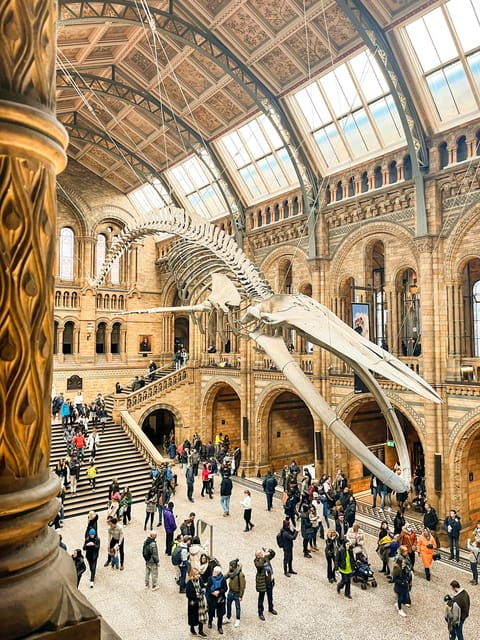
- Sophie the Stegosaurus: See the world’s most complete stegosaurus skeleton, a memorable centerpiece for dinosaur fans.
- A 1,300-year-old tree: A cross-section of Giant Sequoia gives you a striking sense of natural time.
- Pompeii in plaster: Casts of victims from the eruption of Mount Vesuvius bring the human cost of the disaster into view.
- Darwin and Archaeopteryx: See a first edition of On the Origin of Species and a famous fossil linked to the story of birds and dinosaurs.
- Moon and Mars samples: The tour reaches beyond Earth with rocks from the Moon and Mars, plus fine gemstones.
- A short, guided route: The scheduled activity lasts 2.5 hours, with two hours listed for the museum tour itself.
Why this Natural History Museum tour is worth considering
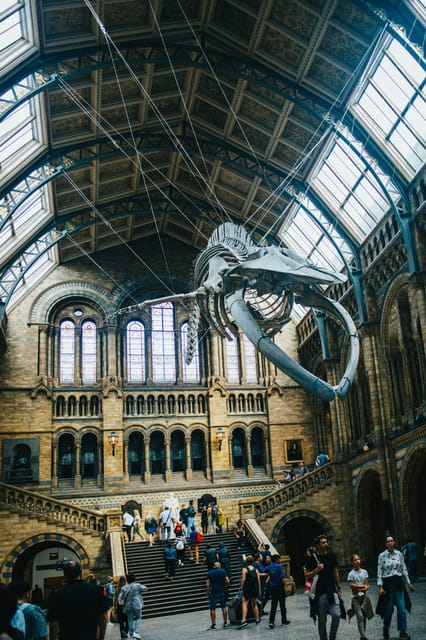
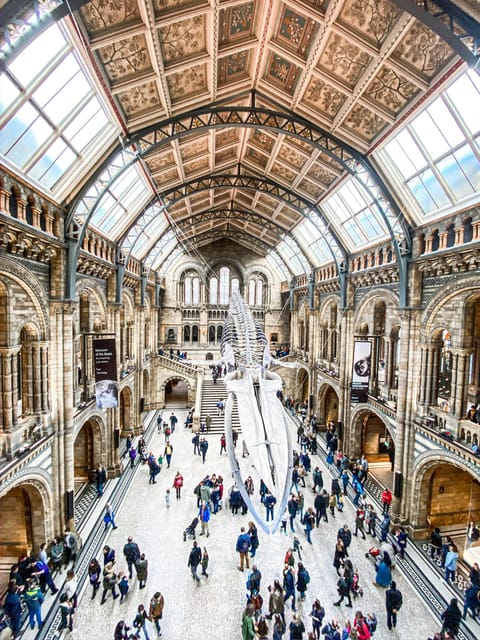
London’s Natural History Museum can feel too large for a first visit. Its collection contains about 80 million specimens, far more than you can sensibly see in one afternoon. A guide gives your visit a clear shape, taking you to the major displays instead of leaving you to choose between endless rooms.
That focus matters most if you have limited time in London. You will not get a full survey of the museum, but you should come away with a strong sample of its best-known objects: dinosaurs, fossils, trees, volcanoes, books, rocks, and gemstones.
I also like the private or small-group format. You can ask questions without competing with a large crowd, and the guide can adjust the pace to suit your group. For families, that personal attention may be the difference between a child staying engaged and drifting toward the nearest exit.
Still, you should judge the price against your own interests. The cost is $93 per person, which may be reasonable for a family that wants structure and explanation. It is harder to justify if you already have a solid grounding in dinosaurs, earthquakes, volcanoes, and minerals. One critical experience described the information as basic, with more detail available elsewhere in the museum.
More History Tours in London
- London: Historic Pubs of Central London Walking Tour
★ 4.9 · 1,065 reviews - London: Soho Music and Historic Pubs Walking Tour
★ 4.9 · 836 reviews - London: Rock ‘n’ Roll History Tour
★ 4.6 · 645 reviews
Meeting at Exhibition Road
You meet outside the red telephone box opposite the Exhibition Road entrance to the Natural History Museum. This is an important detail, since the meeting point is not described as being inside the museum itself.
Plan to arrive with enough time to identify the red telephone box and locate your guide. The tour includes an express security check, which should make entry quicker than using the standard security process. You will still need to pass through museum security, and flash photography is not allowed.
The tour is offered in English. Private and small-group options are available, but the exact group arrangement depends on the booking you choose. If you need a fully accessible visit, take note that this experience is not suitable for wheelchair users.
Sophie the Stegosaurus and the dinosaur story
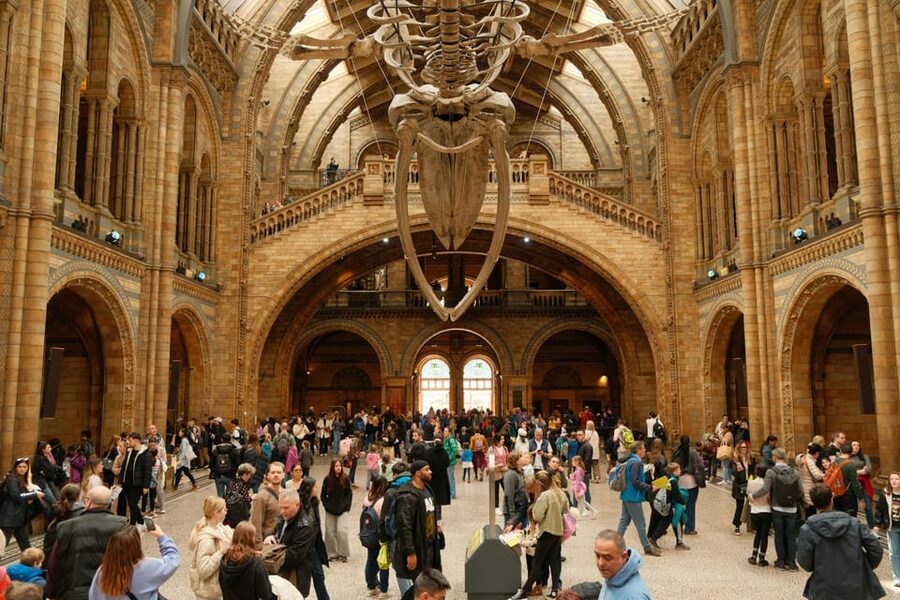
Sophie the Stegosaurus is one of the tour’s strongest stops. You will see the world’s most complete stegosaurus skeleton, giving the guide a useful starting point for explaining how paleontologists read bones and reconstruct animals that disappeared long ago.
A complete skeleton has visual power. You can study the shape of the body, the plates along the back, and the proportions of the animal in a way that a small fossil fragment cannot match. Even if you know little about stegosauruses, this is an easy display to appreciate.
The dinosaur portion continues with Archaeopteryx, a fossil often described as a missing link between birds and dinosaurs. That phrase is familiar, but the specimen itself gives the idea more weight. You are looking at evidence used in the long scientific discussion about how bird features relate to dinosaur ancestors.
This is also where guide quality matters. A short explanation can make Archaeopteryx fascinating, while a string of general facts may leave you wanting more. The positive feedback for Wesley points to the kind of guide who can keep the science moving and answer questions without turning the visit into a lecture.
You will also see the long-extinct Dodo. It is a useful reminder that the museum is not only about prehistoric creatures. Its collections also record animals lost in more recent human history.
A Giant Sequoia measured in centuries
The cross-section of a Giant Sequoia offers a welcome change from bones and fossils. The tree was already 1,300 years old when it was felled in the 19th century, so its rings turn time into something you can see at a glance.
This display works because it makes natural history personal. A number such as 1,300 years can feel abstract. A massive section of wood, marked by rings, gives that span a physical form. The guide can help connect the tree’s age with the human events that occurred during its life, though the supplied tour details do not promise a particular explanation or set of dates.
For me, this is the sort of stop that makes a museum visit feel broader. You move from extinct reptiles to a living organism that survived for many human generations. It also gives families a simple way to think about age, growth, and environmental change.
Do not expect the sequoia to be the only major plant display or a separate outdoor visit. It is a museum object, viewed as part of the guided route.
More Museum Tours in London:
- London: Chelsea Football Club Stadium and Museum Tour
★ 4.8 · 4,576 reviews - London Transport Museum Entrance Ticket
★ 4.5 · 1,323 reviews - London: British Museum Guided Tour
★ 4.3 · 1,182 reviews - London: Jack the Ripper Museum Tickets
★ 4.2 · 894 reviews
Pompeii’s plaster casts and the cost of Vesuvius
The tour then brings you to plaster casts made from the remains of people killed by the eruption of Mount Vesuvius at Pompeii. This is one of the most serious sections of the visit.
The casts are not simply another archaeological curiosity. They show the shape and posture of people caught by a sudden disaster. The display can be difficult to view, especially for younger children, so consider your group before booking.
The stop also gives volcanic science a human scale. Rocks and eruption diagrams can explain what happened, but the casts show that Vesuvius was not only a geological event. It was a catastrophe that affected real people.
The balance of the tour matters here. Dinosaurs and gemstones bring wonder, while Pompeii adds grief and human consequence. That mix gives the museum more emotional range than a simple collection of spectacular objects.
One piece of practical advice: ask your guide questions if the explanation feels too brief. A critical review found the information basic in some areas, particularly around earthquakes, volcanoes, gems, and dinosaurs. Your experience may depend heavily on how much context the guide adds at each stop.
Darwin’s book and the evidence behind evolution
A first edition of Darwin’s On the Origin of Species gives the tour a different kind of highlight. This is not a large fossil or a dramatic mineral. It is a scientific book, and its importance comes from the ideas it presented and the effect those ideas had on the study of life.
Seeing an early edition can help you connect the museum’s physical specimens with the scientists who tried to explain them. The fossils and skeletons are evidence. Darwin’s book represents the attempt to organize evidence into a theory about how species change.
The value of this stop depends on the guide’s interpretation. If you already know the basic argument of evolution, you may want more than a short label. If you are new to the subject, a concise explanation may be exactly right.
The tour does not promise an extended literary or scientific discussion. Think of the book as one stop in a fast-moving highlights route, not a full Darwin seminar.
Gemstones, moon rock, and Mars
The final group of highlights reaches from Earth’s mineral wealth to objects from space. You will see fine gemstones alongside rock from the Moon and Mars.
The gemstones offer color, form, and polish. The lunar and Martian samples shift your attention to the wider solar system. Together, they show how the museum uses objects to explain both the beauty of minerals and the scientific value of rare material.
This pairing also gives the guide several ways to tailor the conversation. Children may respond to the idea of rocks from other worlds. Adults may be more interested in how such samples are identified and studied. The supplied details do not specify the exact specimens, gemstone names, or scientific explanations, so you should treat this as a highlights stop rather than a detailed mineralogy session.
If your main reason for booking is space science, check your expectations. Moon and Mars rock is included among the highlights, but the experience covers many subjects in a limited time. You will see a selection, not every major space-related object in the museum.
How the two-hour route feels
The activity lasts 2.5 hours, while the included museum tour is listed as two hours. That likely means you should allow roughly two and a half hours for the full activity, including meeting, entry, and the guided portion. Confirm the precise starting time when you check availability.
Two hours inside a museum this large is a useful compromise. You get enough time for a meaningful introduction, but not enough to linger at every display. The pace will probably feel brisk if your group asks many questions or wants to stop for photographs.
I would treat the route as an orientation visit. After the guide leaves you with a sense of the museum’s main themes, you may want to return independently for galleries that caught your attention. The tour is not designed to replace a full day at the museum.
The private or small-group setup can help here. A guide who reads the group well can spend more time on Sophie for dinosaur fans, or explain the gemstones and space rocks for a group drawn to geology. Sasha was praised for engaging every member of a family, and that is exactly the strength to look for in this format.
Is $93 per person good value?
The $93 price needs careful thought. You are paying for a guide, a focused route, access to the museum’s main highlights, and an express security check. You are not paying for a full museum education course or an exhaustive examination of the 80 million specimens.
I see the best value for first-time visitors who feel overwhelmed by the museum, families who want a clear plan, and people who enjoy asking questions as they go. The private or small-group format also makes more sense if you value personal attention over the lowest possible price.
The value drops if you already have basic knowledge of dinosaurs, volcanoes, earthquakes, and gemstones. One poor assessment specifically found the commentary too general for someone with that background. In that case, entering the museum on your own and spending the $93 elsewhere may be the better choice.
Guide performance is another part of the calculation. The strongest feedback praised Sasha and Wesley for keeping people interested and making the time pass quickly. One serious complaint reported that the guide was absent and requested a refund. That does not tell you how your own tour will run, but it is a reason to arrive at the stated meeting point and raise any issue promptly.
Free cancellation up to 24 hours before the activity and the option to reserve now and pay later reduce the financial risk of changing plans. Those policies are helpful in a London itinerary, where weather, train delays, and crowded sightseeing days can disrupt your schedule.
Who should book this museum visit?
I would recommend this experience to families, first-time museum visitors, and anyone who wants the big highlights without planning a route through a huge building. The combination of Sophie, Archaeopteryx, the Dodo, Pompeii casts, Darwin, gemstones, and space rocks gives you plenty of variety.
It also suits visitors who learn best through conversation. A live English-speaking guide can connect objects that might otherwise feel unrelated, from a tree ring to a dinosaur skeleton to a lunar rock.
I would be more cautious if you use a wheelchair, since the activity is listed as unsuitable for wheelchair users. I would also hesitate if you want long, technical explanations of one subject. This is a highlights tour, and its broad subject list limits the time available at each stop.
Finally, remember that flash photography is not permitted. You can enjoy the displays, but you need to follow that museum rule during the visit.
Should you book the Natural History Museum tour?
Book it if you want a guided introduction to London’s Natural History Museum and value a small group, a clear route, and help finding the major displays. Sophie the Stegosaurus, Archaeopteryx, the Giant Sequoia, Pompeii casts, Darwin’s book, and rocks from the Moon and Mars make a strong two-hour sampler.
Skip it if you already know the main science and prefer to explore slowly on your own. At $93 per person, the tour earns its price through the guide and convenience, not simply through museum entry. If you book, choose it for the personal explanation and the time saved, and keep your expectations focused on a lively highlights visit rather than a detailed course.
FAQ
How long does the Natural History Museum guided tour last?
The activity duration is listed as 2.5 hours. The included guided museum tour is listed as two hours, so allow about two and a half hours for the complete experience.
How much does the tour cost?
The listed price is $93 per person.
Where is the meeting point?
Meet outside the red telephone box opposite the Exhibition Road entrance to the Natural History Museum.
Is the tour private or shared?
Private or small-group options are available.
What language is the tour conducted in?
The live tour guide provides the experience in English.
Does the tour include the museum’s main highlights?
Yes. The tour includes access to the museum’s main highlights with a guide.
Can you see Sophie the Stegosaurus?
Yes. Sophie the Stegosaurus is one of the featured stops, and the skeleton is described as the world’s most complete stegosaurus skeleton.
Is photography allowed?
Photography is allowed with one stated restriction: flash photography is not permitted.
Is the tour suitable for wheelchair users?
No. The activity is listed as not suitable for wheelchair users.
Just added in London
- The Best of British Cooking Class & Dining Experience★ 5.0 · 1 review
- London: Live Comedy Show at Big Belly Bar and Comedy Club★ 4.5 · 80 reviews
- London: British Museum Highlights Guided Small Group Tour★ 4.9 · 113 reviews
- The Beatles London Walking Tour★ 4.2 · 147 reviews
- The Best Highlights of London Walking Tour & Boat Cruise★ 5.0 · 1 review
- The Authentic Walking Tour with Indian Tasting Meal★ 4.8 · 4 reviews
- Iconic London: Bard, Beatles, Bond & Baker Street★ 4.9 · 15 reviews
- London: Tate Britain Official Discovery Tour★ 4.7 · 7 reviews
Historical Tours, compared.




Other lists this tour turns up in