
REVIEW · NATIONAL GALLERY TOURS
London: National Gallery Guided Tour (Headsets included)
Great art needs a good guide. This National Gallery tour gives you a focused route through some of Europe’s most important paintings, with clear explanations of technique, symbolism, and the human stories behind the works. I especially like the small group of up to 10 people and the included headsets, which should make it easier to hear without crowding around the guide.
I also like the range of artists, from Leonardo da Vinci and Michelangelo to Turner, Monet, Seurat, and Van Gogh. The main drawback is the conflicting timing information: the activity is described as lasting one hour in some places, while the itinerary and inclusions describe a two-hour guided tour. Confirm the exact duration when you book.
In This Review
- Key Points at a Glance
- What This National Gallery Tour Actually Offers
- Meeting the Guide Inside the National Gallery
- Renaissance Drama: Leonardo da Vinci and Michelangelo
- Turner’s Rain, Steam and Speed and the Shock of Industry
- Monet, Seurat, and New Rules for Color
- Van Gogh’s Brushwork and Everyday Scenes
- Why the Headsets and Small Group Matter
- The Duration Confusion and Why It Matters
- Is $24.23 Good Value?
- Who Should Book This Experience?
- Should You Book the National Gallery Guided Tour?
- FAQ
- Where does the National Gallery tour begin?
- Where does the tour end?
- How long does the guided tour last?
- Are headsets included?
- What language is the tour conducted in?
- How early should I arrive?
Key Points at a Glance
- A compact route through major works: See paintings by da Vinci, Michelangelo, Turner, Monet, Seurat, and Van Gogh in one guided visit.
- Small group, maximum 10 people: The limited size should make questions and discussion easier than on a large museum tour.
- Headsets are included: You can listen while standing at a sensible distance from the paintings.
- The guide adds stories, not just dates: The tour focuses on symbolism, artistic choices, and how each painter challenged accepted rules.
- Arrive 45 minutes early: Security can take time, and the tour begins on schedule with no late entry.
- Useful for newcomers and art fans: The route covers major names but still explains why the paintings matter.
What This National Gallery Tour Actually Offers
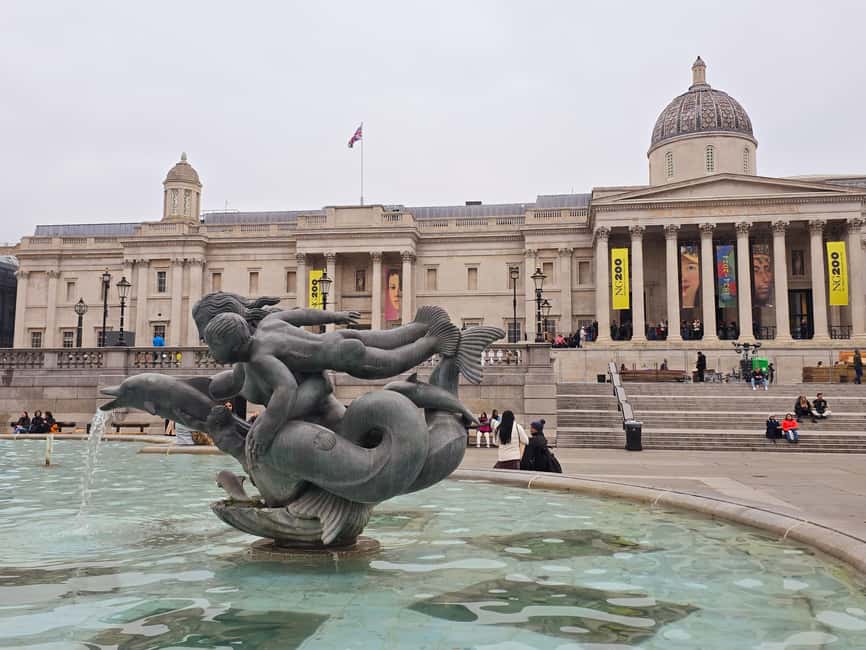
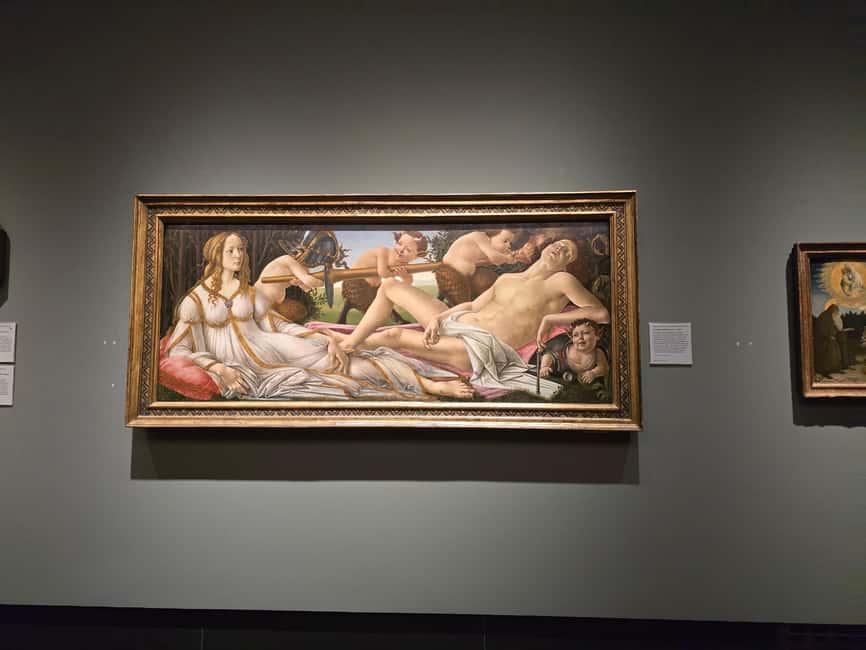
The National Gallery can be hard to approach on your own. Its rooms hold centuries of European painting, and the sheer number of famous works can leave you wandering from one celebrated canvas to another without a clear sense of how they connect.
This tour gives you a route and a story. Instead of trying to see everything, you move through selected paintings that show how artists changed the way people depicted religious subjects, people, nature, industry, and ordinary life.
The strongest part of the experience is the guide’s interpretation. You are not simply told who painted each work and when. You learn how artists used composition, brushwork, color, symbolism, and light to express an idea.
That matters at the National Gallery because the paintings can look very different when you know what to look for. A religious scene may contain small clues about status or belief. A stormy modern scene may reflect a changing industrial world. A still pond may be built from short strokes of color rather than smooth, blended paint.
The tour is conducted in English, with a live guide and English audio equipment. The headsets are particularly useful in a museum, where voices can get lost among high ceilings, other groups, and the quiet pressure to speak softly.
More National Gallery visits:
- London: National Gallery Guided Tour with Art Expert Guide
★ 4.7 · 440 reviews - London: National Gallery of London Masterpieces Guided Tour
★ 4.9 · 78 reviews - London: National Gallery Guided Tour
★ 3.8 · 67 reviews
Meeting the Guide Inside the National Gallery
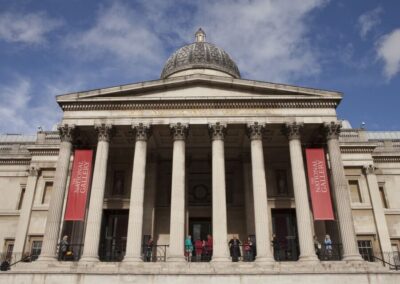
The meeting point is inside the museum, in front of the cloakroom and toilets. This is worth noting because you are not meeting outside on Trafalgar Square or at a nearby street corner.
Plan to reach the museum about 45 minutes before the scheduled start. Security lines can be long, and the tour starts on time. If you arrive late, you will not be able to join, so this is not the place to cut things close after a delayed train or a slow lunch.
Once you meet the guide, you receive the headsets and begin the guided route through the museum. The group is limited to 10 people, a useful size for a gallery visit. You should have a better chance to ask a question or hear a point clearly than you would on a tour with several dozen people.
Wear comfortable shoes. The tour takes place inside a large museum, and even a short route can involve plenty of standing. Flash photography is not allowed.
Renaissance Drama: Leonardo da Vinci and Michelangelo
The first section focuses on Renaissance painting and the way artists transformed the portrayal of people and religious subjects.
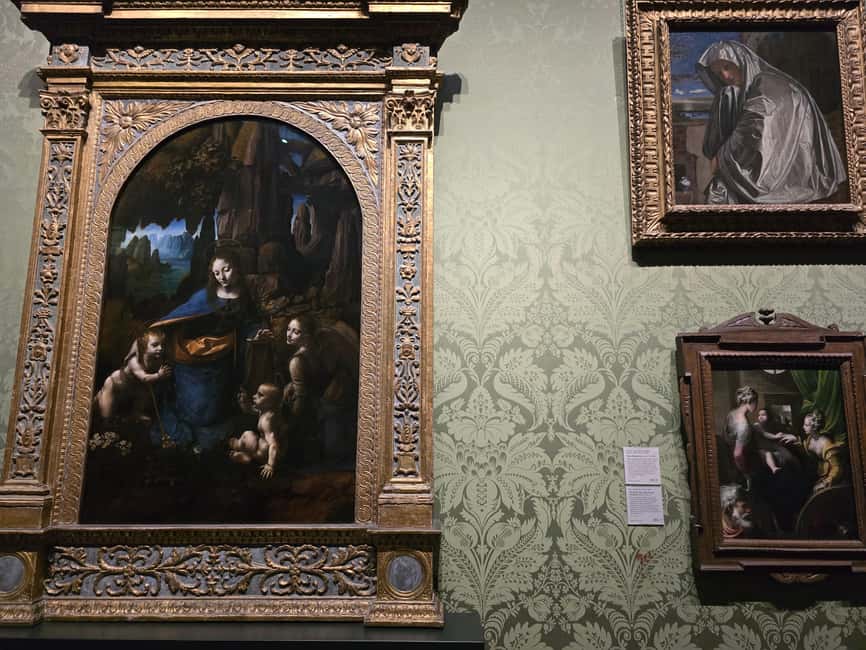
Leonardo da Vinci’s The Virgin of the Rocks offers a chance to look at his subtle treatment of faces, bodies, and atmosphere. The painting is not simply a scene to admire from a distance. Your guide can point out how Leonardo creates a sense of connection between the figures and how the surrounding setting contributes to the mood.
This is where guided commentary earns its keep. Without explanation, you might notice the soft edges and carefully arranged figures but miss the larger artistic problem Leonardo was solving: how to make a sacred scene feel human, believable, and emotionally connected.
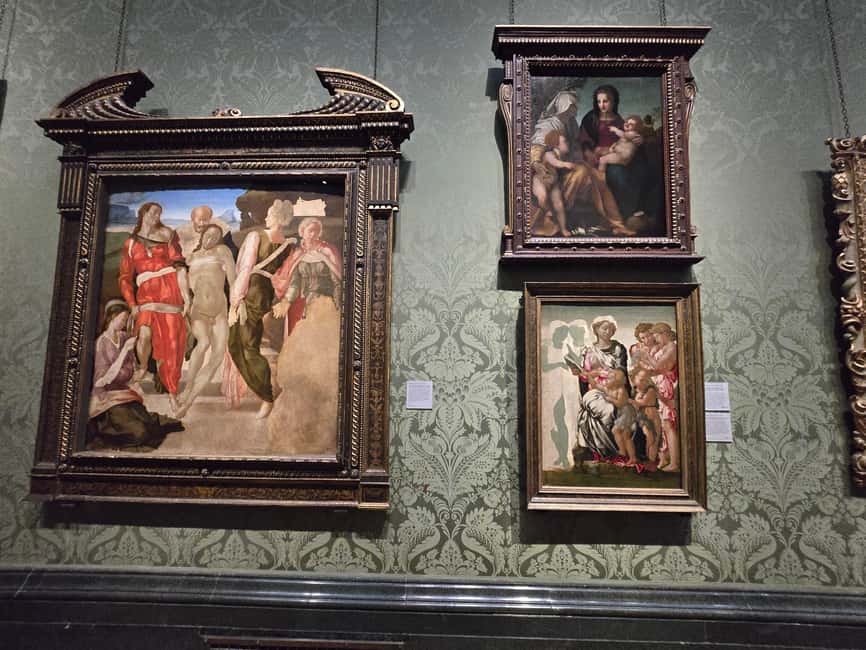
You also see Michelangelo’s The Entombment, described here as his only surviving easel painting. That detail alone gives the work unusual importance. It also makes the painting a useful counterpoint to the better-known image many people carry of Michelangelo as a sculptor and painter of huge religious frescoes.
The guide places these works within the wider changes of the Renaissance. Human figures became more convincing, bodies gained weight and presence, and religious subjects were given greater emotional force. You are encouraged to look at how realism works in practice, not just accept the broad claim that Renaissance artists made art more lifelike.
For an art beginner, this section provides a strong foundation. For someone who already knows the period, the value lies in examining technique and symbolism rather than simply ticking off famous names.
Turner’s Rain, Steam and Speed and the Shock of Industry
The route then moves into the 18th and 19th centuries with J.M.W. Turner’s Rain, Steam and Speed. The painting captures a train moving through weather, but it also suggests the excitement and unease of the Industrial Revolution.
Turner’s handling of light and motion gives the work its force. The train is not presented as a neat, sharply outlined machine. Instead, the surrounding weather and speed blur the scene. A guide can help you see why that choice was so radical and why the painting is about more than a locomotive crossing a bridge.
This is one of the tour’s most useful moments because it connects art with a major change in daily life. Railways altered how people moved, worked, and understood distance. Turner responds to that new world with a painting that feels unstable and energetic.
You may find this section especially helpful if you usually think of museum art as separate from politics, technology, or social change. Here, artistic technique and modern life are closely tied together.
The painting also breaks up the Renaissance material nicely. Rather than moving through a long parade of religious images, the tour shifts its subject and mood. That variety helps a one or two-hour visit keep its pace.
More Museum Tours in London:
- London: Chelsea Football Club Stadium and Museum Tour
★ 4.8 · 4,576 reviews - London Transport Museum Entrance Ticket
★ 4.5 · 1,323 reviews - London: British Museum Guided Tour
★ 4.3 · 1,182 reviews - London: Jack the Ripper Museum Tickets
★ 4.2 · 894 reviews
Monet, Seurat, and New Rules for Color
The Impressionist section turns attention toward light, color, and brushwork.
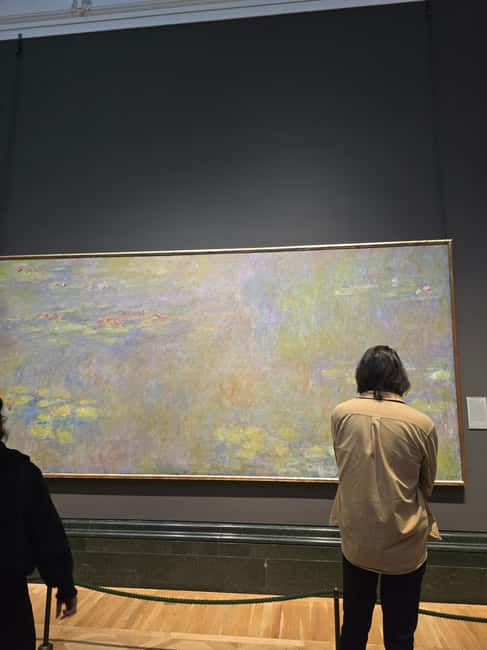
Claude Monet’s The Water-Lily Pond is a natural choice for discussing how a familiar scene can become an experiment in changing light and color. A pond may sound simple, but Monet’s treatment asks you to look at reflections, atmosphere, and the surface of water as an active part of the image.
The guide also introduces Georges Seurat’s Bathers at Asnières. Seurat’s approach to color and brushwork differs from Monet’s, and seeing the two within the same tour helps you understand that Impressionism was not one single formula.
These paintings challenged conventional rules. Artists were testing how viewers perceive color and light rather than presenting every object with firm outlines and carefully polished surfaces.
I like this part of the route because it gives you practical things to look for. Notice how color can suggest shadow. Look at how small marks work together from a distance. Pay attention to how an apparently casual outdoor scene may be carefully structured.
The paintings also show why a guided visit can be better than a quick walk through the gallery. You might recognize Monet’s name and enjoy the colors, but commentary gives you a way to understand the decisions behind the effect.
Van Gogh’s Brushwork and Everyday Scenes
The final section turns to Vincent van Gogh and his expressive use of paint.
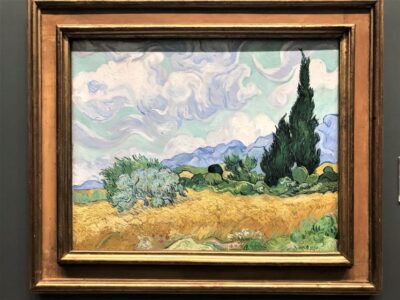
Van Gogh’s work is often reduced to a few familiar ideas: bright colors, swirling brushstrokes, and personal emotion. The guide goes beyond that shorthand by explaining how his brushwork and color choices give ordinary scenes extra force.
The point is not only that Van Gogh painted with feeling. It is that the paint itself carries movement and intensity. Brushstrokes direct your eye and make the surface of the canvas part of the subject.
This closing section should appeal to people who know little about art because the visual effect is immediate. You can see the energetic marks before you understand the full artistic context. The guide then helps connect what you see with Van Gogh’s way of rethinking familiar subjects.
Ending with Van Gogh also gives the tour a strong sense of progression. You begin with Renaissance realism and religious symbolism, move through industrial modernity, then arrive at artists who treat color and brushwork as powerful subjects in their own right.
Why the Headsets and Small Group Matter
Museum tours can fail for a simple reason: you cannot hear the guide. The headsets solve much of that problem. You can stand at an appropriate distance from the artwork and still follow the explanation.
The equipment also helps the group move through busy rooms without forming a tight knot around each painting. That makes the experience more comfortable and gives you a clearer view.
A maximum of 10 participants is another strong feature. It does not guarantee a quiet gallery or unlimited time at each work, but it creates better conditions for questions and conversation. The tour is described as interactive, so you can ask about a technique, a symbol, or your own response to a painting.
The published feedback is especially positive about the guide’s passion and storytelling. One response praised the stories behind the paintings and said the experience led to learning a great deal about art. Another said the route covered the most important paintings within the available time and offered useful insight into many works.
That is the right expectation. You are not buying a private art lesson or an exhaustive survey of the National Gallery. You are paying for a well-chosen introduction led by someone who can make famous paintings easier to understand.
The Duration Confusion and Why It Matters
Pay close attention to the timing when you reserve. The experience is described as one hour in the general activity details, but the itinerary says two hours, and the inclusions also specify a two-hour guided tour.
That difference is significant. A one-hour tour gives you a quick introduction and a brisk selection of highlights. A two-hour tour allows more time for the Renaissance, Turner, Impressionism, and Van Gogh, with room for questions.
Because the route includes several major periods and artists, the two-hour description appears to fit the promised content better. Still, you should check the available starting time and confirmed duration before paying.
The tour ends back at the meeting point inside the National Gallery. Transportation to and from the museum is not included, and there is no food or drink included.
Is $24.23 Good Value?
At $24.23 per person, the price is reasonable for a guided visit that includes museum access, a live English-speaking guide, and headsets. The value comes from the interpretation rather than from admission alone.
The National Gallery is a major museum, and you can easily spend hours there without paying for a guide. But independent entry does not tell you which rooms to visit, how the paintings relate to each other, or what details are worth your attention.
This tour makes the most sense if you have limited time in London or feel unsure about reading paintings on your own. It can also work well at the beginning of a longer museum visit. After the tour ends, you can return to a favorite painting and look at it again with a better sense of what you are seeing.
The price is less compelling if you already know the National Gallery well or prefer to set your own pace. A guided route means accepting the guide’s selection and spending less time on works outside that route.
Still, the small group and headsets improve the value. The strongest praise focuses on the guide’s passion, stories, and ability to cover important paintings in the time available. Those are exactly the features that separate a useful museum tour from a fast walk past famous canvases.
Who Should Book This Experience?
I would recommend this tour to first-time National Gallery visitors, people with only a short window in London, and anyone who wants a clear introduction to Western European painting.
It is also a good choice for families with older children or mixed-interest groups. A story about a painting, a train, or a striking use of color can hold attention better than a list of dates and movements.
Art lovers may enjoy it too, especially if they want to focus on technique and symbolism. Just keep your expectations realistic. The tour selects highlights rather than attempting to cover the entire collection.
The experience is conducted in English, so you should be comfortable following spoken English through a headset. The information describes it as wheelchair accessible, but it also says it is not suitable for people with mobility impairments. That is a contradiction worth clarifying directly before booking if access is important to you.
Should You Book the National Gallery Guided Tour?
Book it if you want a short, focused introduction to major National Gallery paintings and prefer to learn through stories and explanation rather than wandering alone.
The guide’s passion receives the clearest praise, and the route includes an appealing spread of artists: da Vinci, Michelangelo, Turner, Monet, Seurat, and Van Gogh. The headsets and 10-person limit add practical value, while the $24.23 price is fair for guided access.
Skip it if you want complete freedom, long periods with one painting, or a full museum survey. Before booking, verify the one-hour versus two-hour duration and ask about mobility access if needed. Arrive early, wear comfortable shoes, and remember that the tour will not wait for late arrivals.
FAQ
Where does the National Gallery tour begin?
The meeting point is inside the National Gallery, in front of the cloakroom and toilets.
Where does the tour end?
The activity ends back at the same meeting point inside the National Gallery.
How long does the guided tour last?
The information gives both one hour and two hours as the duration. The itinerary and included services describe a two-hour guided tour, so confirm the exact length when checking availability.
Are headsets included?
Yes. Headsets are included with the guided tour, along with English commentary.
What language is the tour conducted in?
The live guide and audio equipment are in English.
How early should I arrive?
Arrive about 45 minutes before the scheduled start to allow time for security. The tour begins on time, and late arrivals cannot join.
Just added in London
- The Best of British Cooking Class & Dining Experience★ 5.0 · 1 review
- London: Live Comedy Show at Big Belly Bar and Comedy Club★ 4.5 · 80 reviews
- London: British Museum Highlights Guided Small Group Tour★ 4.9 · 113 reviews
- The Beatles London Walking Tour★ 4.2 · 147 reviews
- The Best Highlights of London Walking Tour & Boat Cruise★ 5.0 · 1 review
- The Authentic Walking Tour with Indian Tasting Meal★ 4.8 · 4 reviews
- Iconic London: Bard, Beatles, Bond & Baker Street★ 4.9 · 15 reviews
- London: Tate Britain Official Discovery Tour★ 4.7 · 7 reviews
National Gallery Tours, compared.
National Gallery Guided Tour with Art Expert Guide
Read our review →
National Gallery of London Masterpieces Guided Tour
Read our review →
Private Tour of the National Gallery with tickets
Read our review →
British Museum & National Gallery Highlight Tour 8 guests 5h
Read our review →Other lists this tour turns up in