
REVIEW · BRITISH MUSEUM TOURS
London: British Museum Guided Tour with Priority Entrance
History rewards a good guide. This two-hour British Museum tour gives you a useful route through a collection far too large to tackle sensibly on a first visit. I especially like the Great Court’s glass roof and the way guides such as Antonio, Mira, Alex, Tony, Tara, and James connect famous objects to clear stories. The main drawback is simple: two hours can only introduce the museum, not cover it.
I also like the priority timed entrance, which can make arrival easier on a busy London day, plus the headsets that help you hear commentary in crowded galleries. You will need to meet the guide inside by the information desk, so follow the entry instructions carefully. The tour is not suitable for wheelchair users, people with mobility impairments, babies under one year, or people with hearing impairments.
In This Review
- Key points to know before booking
- Why a two-hour introduction makes sense
- Meeting the guide at 52 Great Russell Street
- The Great Court and the museum’s grand first impression
- Ancient Greece and the Parthenon Sculptures
- Egyptian mummies, the Rosetta Stone, and royal power
- The Enlightenment Room and the idea of collecting
- Chinese and Southeast Asian collections
- Sutton Hoo and Anglo-Saxon England
- How the guides shape the experience
- Is $53.87 good value?
- Who should book this British Museum tour?
- Should you book it?
- FAQ
- How long does the British Museum guided tour last?
- Where does the tour meet?
- Where does the activity finish?
- Is priority entrance included?
- What languages are available?
- Are headsets provided?
- What are the main objects included?
- Is transportation included?
- Can I cancel the booking?
Key points to know before booking
- The route covers world-famous highlights: Expect the Parthenon Sculptures, Egyptian mummies, the Rosetta Stone, Sutton Hoo treasures, and more.
- The Great Court is part of the experience: Its sweeping glass ceiling gives you an impressive first look at the museum before the gallery visit begins.
- A guide helps you choose: With more than 8 million objects across over 70 galleries, a planned route saves you from wandering without a sense of direction.
- Headsets help in crowded rooms: You can hear the guide while looking at the exhibits instead of standing shoulder to shoulder around one person.
- The pace is brisk but focused: The tour gives you a broad introduction, then leaves you free to continue on your own.
- The price is $53.87 per person: That is a reasonable fee if you value expert interpretation and a timed entrance, but less appealing if you only want to walk through the museum independently.
Why a two-hour introduction makes sense
The British Museum is not a small collection with a neat beginning and end. It holds more than 8 million artefacts, displayed in over 70 galleries. You could spend days here and still leave with rooms unseen.
That scale creates a problem for a first visit. You may enter with a list of famous objects, then lose time finding the right gallery, reading long labels, or crossing the building several times. This tour solves part of that problem by giving you a route and a basic story of human culture across several regions and periods.
The strongest reason to book is not simply getting inside. The museum is free to enter in general, but this paid experience adds a timed priority entrance, a live guide, and a structured visit. You are paying for direction and interpretation. If you like to understand why an object matters, rather than just photograph it, the fee can be worthwhile.
The format also suits a short London stay. You can spend two hours seeing the main pieces, then decide what deserves another look. One useful feature is that the tour ends back at the meeting point, allowing you to continue exploring independently afterward.
More British Museum visits:
- London: British Museum Guided Tour
★ 4.3 · 1,182 reviews - London: Tour of the British Museum
★ 4.1 · 678 reviews - London: British Museum Audio Tour & Priority Entrance Ticket
★ 4.5 · 631 reviews
Meeting the guide at 52 Great Russell Street
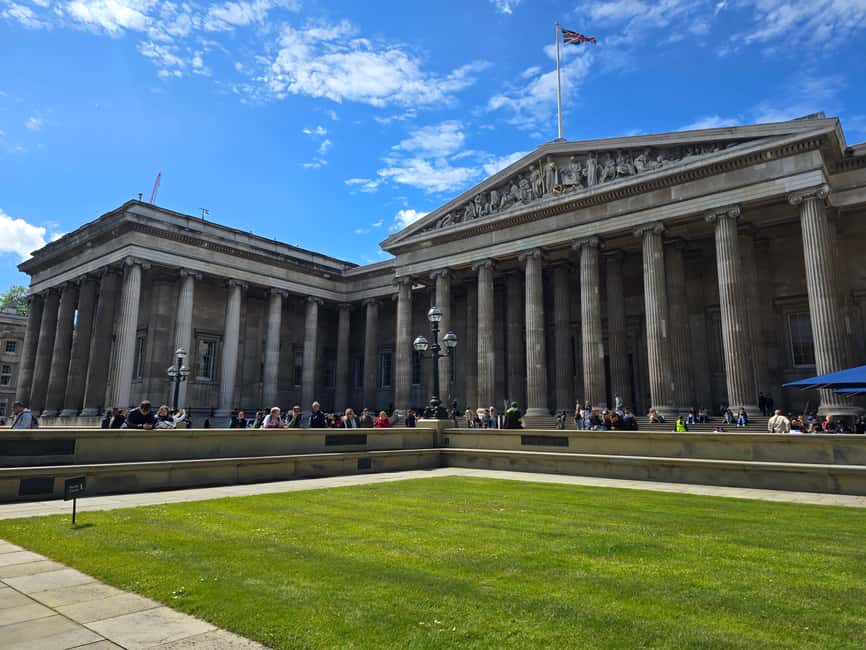
The listed starting point is 52 Great Russell Street, but the guide waits inside the museum next to the information desk. That detail matters. You are not simply meeting a guide outside and walking in as one group.
Your booking includes a main entrance ticket with an allocated time slot and priority access through a separate entrance. Allow enough time to reach the museum, pass through the entrance process, and locate the information desk. If you arrive at the outside address and cannot see the guide, go inside and check the information area rather than waiting on the pavement.
The tour does not include transport, food, or drinks. Plan your journey to the museum separately. Since the activity lasts two hours and finishes at the same meeting point, you can arrange lunch or another central London sight afterward without needing a complicated transfer.
The group may be small, which is a real advantage in a museum where large parties can become difficult to manage. Smaller numbers make it easier to ask questions and stay close to the guide. The guides have also been praised for checking that everyone is present and keeping the group together in crowded rooms.
The Great Court and the museum’s grand first impression
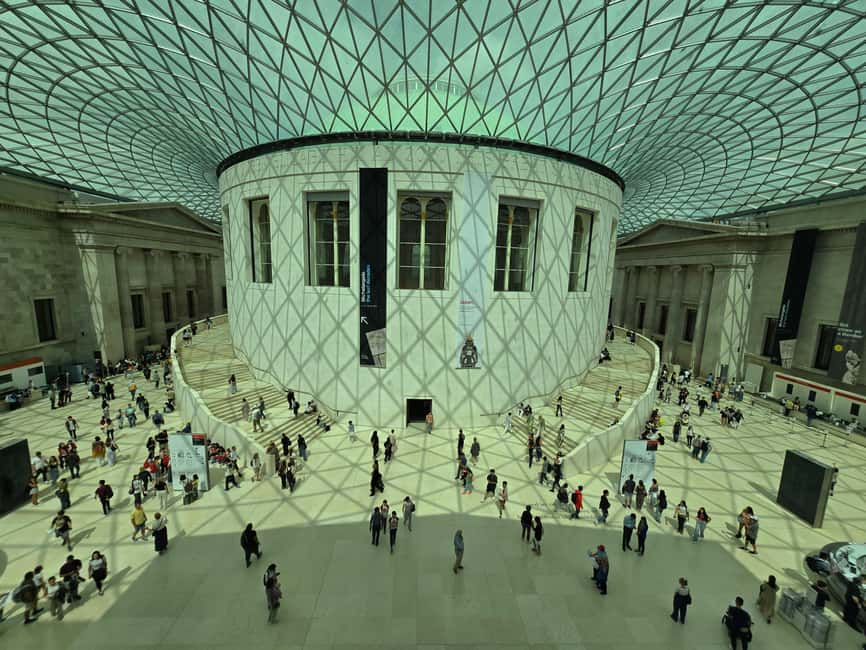
The tour begins with a view of the Great Court, one of the museum’s most memorable spaces. The pale, geometric glass roof covers the central courtyard and turns what might otherwise be a passageway into an attraction in its own right.
This is a smart opening. Before you begin looking at individual objects, you get a sense of the institution’s scale and design. It also gives the guide a natural place to explain how the visit will work and how the galleries connect.
Take a moment to look upward. It is easy to hurry past the ceiling while focusing on the exhibits, but the roof is one of the few parts of the building that can be appreciated quickly from almost anywhere in the court. If you are meeting a guide here, listen for instructions before stopping for photographs, since the group needs to move together.
The Great Court also helps you understand why a route matters. From this central area, the museum spreads into a maze of galleries. A guide who knows the order of the rooms can keep the visit moving instead of sending you back and forth.
Ancient Greece and the Parthenon Sculptures
The Parthenon Sculptures, also called the Elgin Marbles, are among the museum’s best-known objects. The tour uses them to introduce ancient Greek art, myth, and the stories connected with the sculptures.
You should expect more than a quick photo stop. A good guide can point out how the figures and scenes worked together, then place them within the wider world of Greek religion and public art. The supplied tour information also notes myths and legends, so this part should appeal to you if you prefer stories and visual details to a string of dates.
This is also a room where time can disappear. The sculptures deserve close attention, but the larger tour still has Egypt, Asia, Anglo-Saxon England, and other sections to cover. You may feel ready to stay longer just as the group moves on.
That is one of the tradeoffs of the two-hour format. You gain a broad picture, but you do not get unlimited time at each object. Make a note of the rooms that interest you most. You can return after the guided portion and study them at your own pace.
More Museum Tours in London:
- London: Chelsea Football Club Stadium and Museum Tour
★ 4.8 · 4,576 reviews - London Transport Museum Entrance Ticket
★ 4.5 · 1,323 reviews - London: Jack the Ripper Museum Tickets
★ 4.2 · 894 reviews - Afternoon Tea at the British Museum
★ 4.2 · 511 reviews
Egyptian mummies, the Rosetta Stone, and royal power
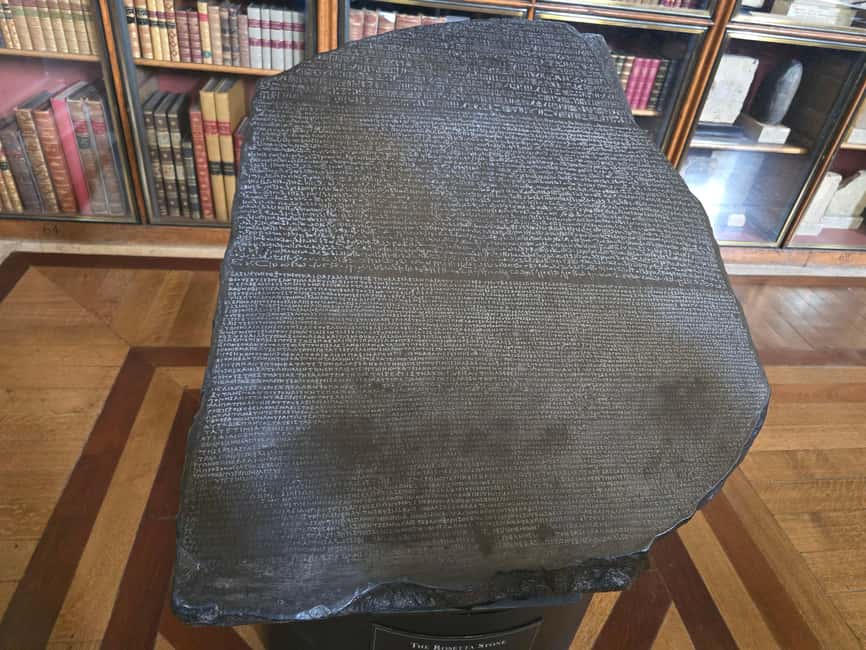
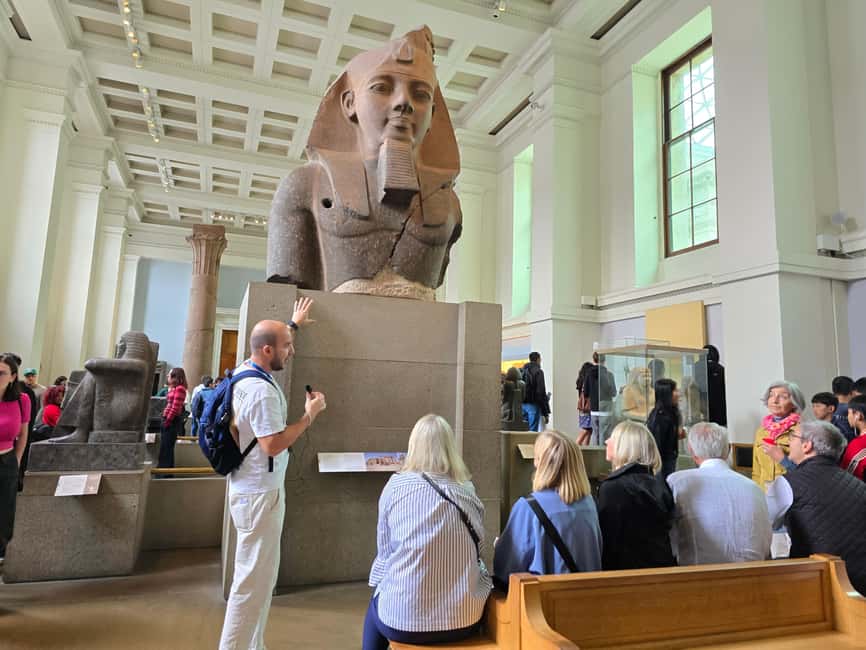
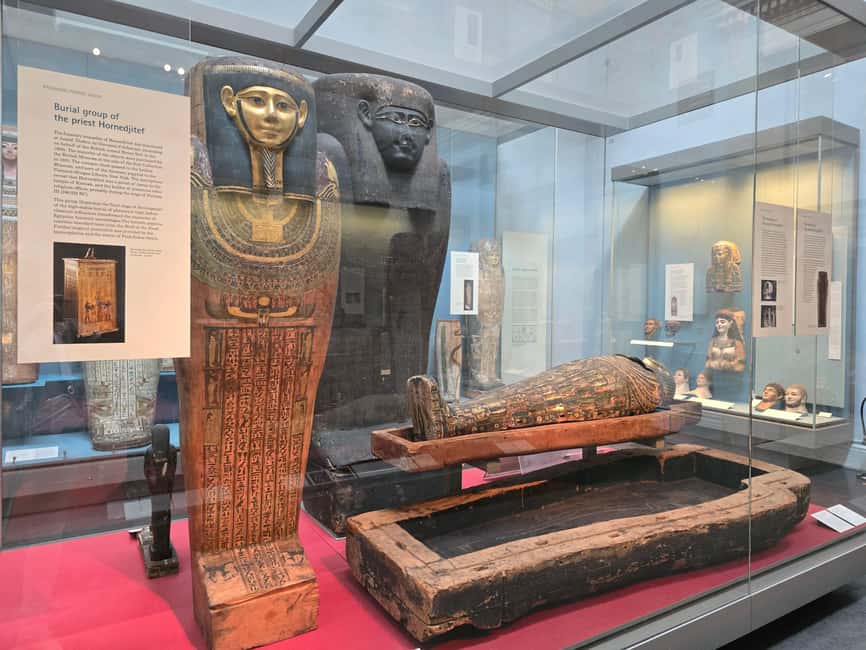
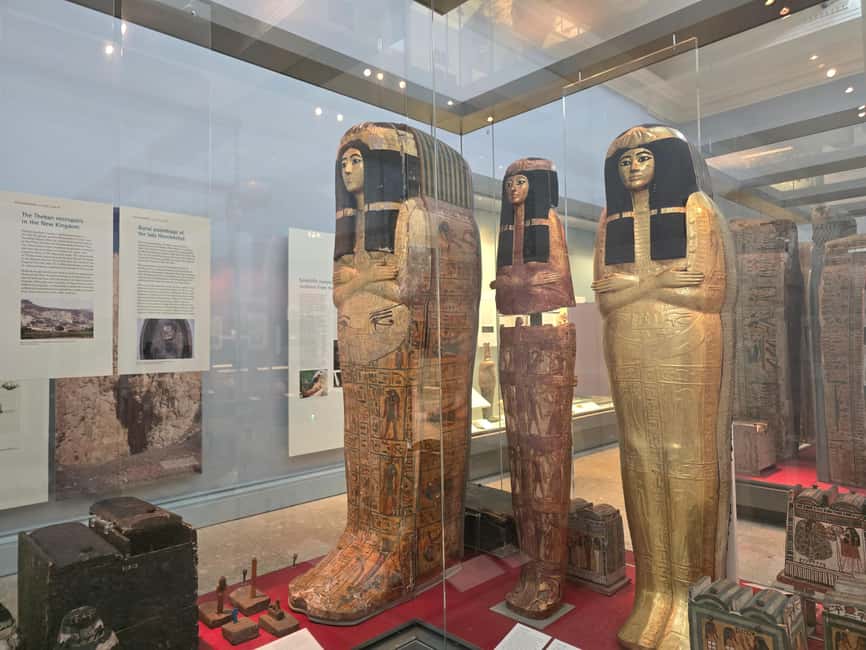
The Egyptian galleries provide some of the tour’s most recognizable sights. You will see Egyptian mummies, the Book of the Dead, the bust of Ramesses II, and the Rosetta Stone.
The value of a guide here is context. Mummies can become a row of ancient bodies behind glass if you only read the shortest labels. With commentary, you can connect burial practices to religious beliefs and understand why objects such as the Book of the Dead mattered to the people who used them.
The Rosetta Stone is famous because it helped scholars read Egyptian hieroglyphs, but the object is more rewarding when you consider its inscriptions and its role in the study of ancient Egypt. The tour also places the bust of Ramesses II within the setting of pharaonic power, giving you a more connected look at the gallery rather than a list of separate attractions.
Several people who have taken this experience especially liked the guides’ ability to explain hieroglyphics and tell stories about the objects. Antonio, in particular, was praised for putting individual pieces into a wider world-history setting. That approach is useful if you want to understand links between art, belief, politics, and daily life.
The Egyptian section can also be popular and crowded. Your headset should make it easier to hear without standing directly beside the guide. Flash photography is not allowed, so keep your camera’s flash turned off.
The Enlightenment Room and the idea of collecting
The Enlightenment Room shifts the focus from ancient civilisations to the 18th century. Its objects reflect curiosity, scientific work, scholarship, and the desire to classify the world.
This room adds balance to the tour. You are not only looking at monumental sculpture or royal tomb objects. You are also seeing how people in another age gathered information and tried to make sense of nature, culture, and the past.
I like this stop because it invites a different question: who collected these objects, and why? The room can help you think about the museum itself as a place shaped by exploration, scholarship, and changing ideas. The guide’s interpretation is particularly useful here, since the significance may not be obvious from one striking object.
Do not expect a long seminar on every display. The guide has to keep the route moving. Instead, treat this as a concise introduction to an important part of the museum’s story, then return if the subject catches your interest.
Chinese and Southeast Asian collections
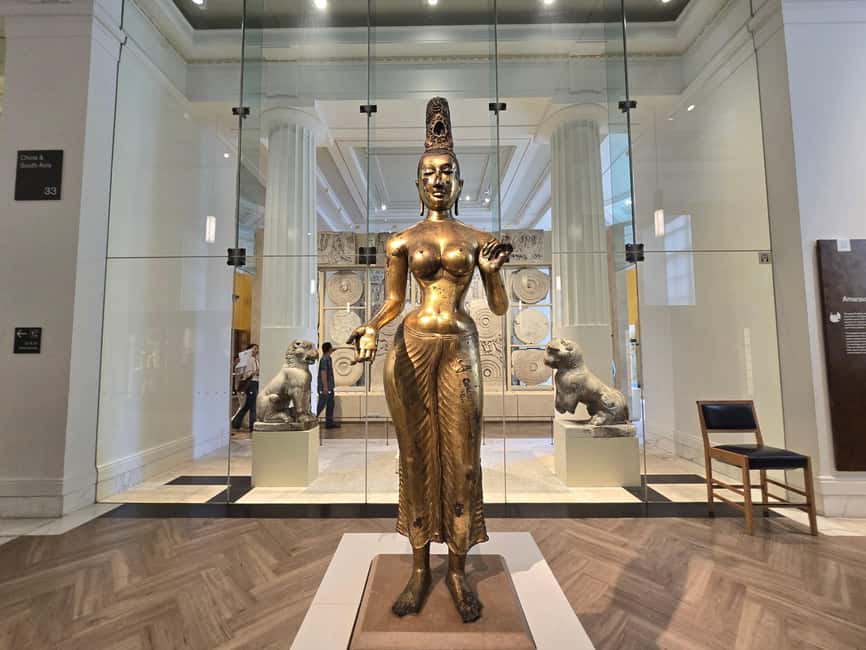
The tour also includes selected Chinese and Southeast Asian artefacts. This section gives you a wider view of artistic traditions beyond the Mediterranean and Europe.
The collection is presented as a chance to consider craftsmanship, regional traditions, and the histories of Asian societies. You may see finely made objects that receive less attention from first-time visitors than the Rosetta Stone or the mummies. That variety is one of the tour’s strengths.
The exact objects shown can depend on the guide’s route, gallery access, and timing. You should think of this as a guided sample rather than a full survey of Asia. If Chinese or Southeast Asian art is your main reason for visiting, ask at the start how much time the route can give that area.
Guides Mira and Alex were praised for moving between different parts of the museum and making sure the tour included more than one region. That broad approach works well for you if you want an overview of world cultures rather than a specialist visit devoted to one civilisation.
Sutton Hoo and Anglo-Saxon England
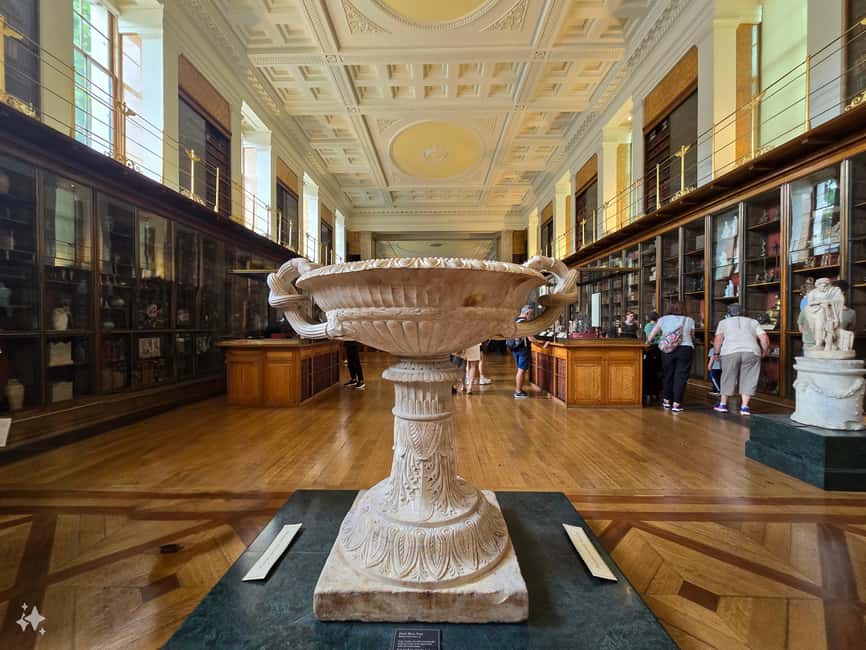
The Sutton Hoo ship burial brings the tour into early medieval England. The helmet, shield, and other burial objects show the level of skill available in Anglo-Saxon society and offer clues about status, warfare, ceremony, and trade.
This is an especially useful stop for anyone who thinks the museum is mainly about Egypt, Greece, and Rome. Sutton Hoo gives the route a British chapter and shows that the collection also includes major discoveries from the country’s own past.
The helmet is the obvious star, but try to look at the surrounding objects as a group. A burial deposit can tell you more than one isolated artefact. The guide can help explain how the objects work together to reveal something about the person or community connected with the burial.
By this point, you will have crossed a wide stretch of time and geography. That is the tour’s central achievement. It does not allow a full examination of every gallery, but it gives you a framework for returning later with more purpose.
How the guides shape the experience
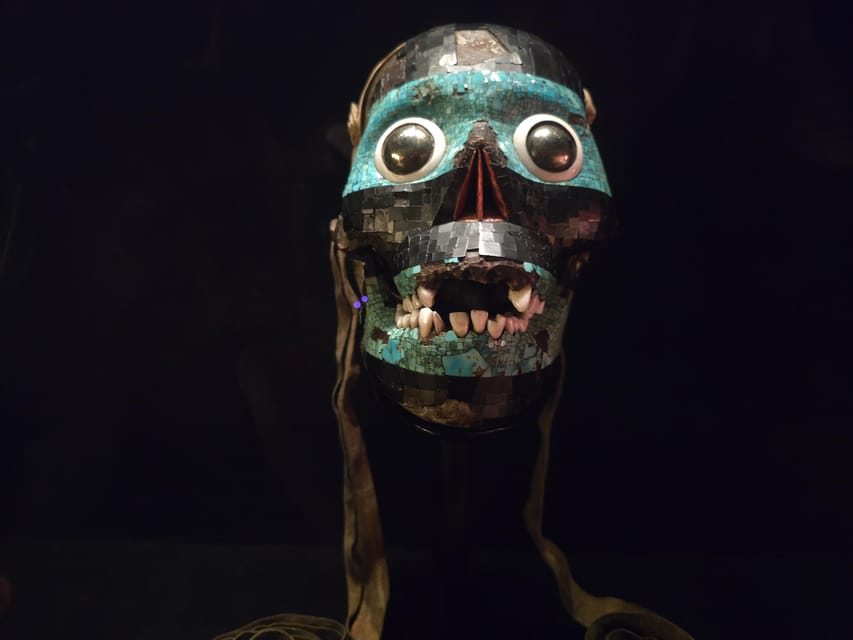
The strongest praise for this experience has focused on the guides’ clear storytelling, care, and ability to keep people together. Names that appear repeatedly include Mira, Alex, Antonio, Tony, Tara, and James.
You can expect the guide to lead you through key objects, add background stories, answer questions, and point out where to return for more time. Several guides were described as friendly and willing to adapt the visit to the group’s interests. In one case, a small group booking became a private tour when other participants cancelled, creating more time for conversation.
That kind of personal attention cannot be guaranteed, but it shows why group size matters. A smaller group makes it easier to ask about a detail, pause briefly, or tell the guide what interests you most.
The headsets are another practical plus. In a large room, the guide’s natural voice may not carry far. An earpiece lets you look at the object while listening, and the equipment has been praised for working well. If you have hearing difficulties, however, the activity is specifically listed as unsuitable, so this is not a substitute for an accessibility service.
The advertised live-guide languages are English, Italian, and Chinese. The inclusion details list commentary in English and Italian, so check the available language and departure time when you book if that choice is important to you.
Is $53.87 good value?
At $53.87 per person, this is not the cheapest way to enter the British Museum, especially since general museum admission is not normally charged. The price makes sense when you place value on the timed priority entrance and two hours of guided interpretation.
I would consider it good value for a first visit, a short stay, or anyone who feels overwhelmed by huge museums. You receive a planned route through major galleries, commentary, headsets when available, and the chance to ask questions. You also keep the option of staying afterward to explore alone.
I would be more cautious if you already know exactly which galleries you want to study. A self-guided visit may give you more freedom and more time at specialist collections. You are also paying for a brisk overview, so do not book this expecting a slow, detailed examination of every famous object.
Free cancellation up to 24 hours before the activity and reserve-now, pay-later booking make the purchase less rigid. Those terms are useful when your London schedule is still changing.
Who should book this British Museum tour?
I would recommend it to you if:
- You are visiting the British Museum for the first time.
- You have only two or three hours available.
- You want the major highlights explained in plain language.
- You enjoy connecting objects from different civilisations.
- You prefer asking a live guide questions instead of reading every label alone.
- You want priority timed entry and a clear meeting arrangement.
I would choose another format if you need step-free access, use a wheelchair, have a mobility impairment, or rely on hearing support. The activity is also not suitable for babies under one year.
Bring comfortable shoes and keep your schedule flexible enough to remain after the tour if the Egyptian galleries, Sutton Hoo, or Asian collections catch your attention. The tour gives you the map; your extra time lets you follow your own interests.
Should you book it?
Book this tour if you want a well-paced first look at the British Museum, with famous objects, useful context, and a guide who can prevent the collection from becoming an exhausting blur. The highest praise has gone to guides who combine facts with stories, keep groups together, and make room for questions.
Skip it if you prefer complete independence or plan to spend a full day on one specialist section. For most first-time visitors with limited time, $53.87 buys something valuable: not just entry, but a sensible way to begin understanding one of London’s biggest museums.
FAQ
How long does the British Museum guided tour last?
The guided tour lasts two hours. You may continue exploring the museum independently after the guided portion.
Where does the tour meet?
Your guide waits inside the British Museum next to the information desk. The listed starting address is 52 Great Russell Street.
Where does the activity finish?
The activity finishes back at the meeting point inside the museum.
Is priority entrance included?
Yes. The experience includes a priority ticket for the main entrance with an allocated time slot and access through a separate entrance.
What languages are available?
Live guiding is advertised in English, Italian, and Chinese. The included commentary is listed as English and Italian, so check the language option when selecting your time.
Are headsets provided?
Headsets are available as an option and are intended to make the guide’s commentary easier to hear in the museum.
What are the main objects included?
The route includes the Great Court, the Parthenon Sculptures, Egyptian mummies, the Book of the Dead, the bust of Ramesses II, the Rosetta Stone, the Enlightenment Room, Chinese and Southeast Asian collections, and Sutton Hoo artefacts.
Is transportation included?
No. You must arrange your own transportation to and from the British Museum. Food and drinks are also not included.
Can I cancel the booking?
You can cancel up to 24 hours in advance for a full refund. Reserve-now, pay-later booking is also available.
Just added in London
- The Best of British Cooking Class & Dining Experience★ 5.0 · 1 review
- London: Live Comedy Show at Big Belly Bar and Comedy Club★ 4.5 · 80 reviews
- London: British Museum Highlights Guided Small Group Tour★ 4.9 · 113 reviews
- The Beatles London Walking Tour★ 4.2 · 147 reviews
- The Best Highlights of London Walking Tour & Boat Cruise★ 5.0 · 1 review
- The Authentic Walking Tour with Indian Tasting Meal★ 4.8 · 4 reviews
- Iconic London: Bard, Beatles, Bond & Baker Street★ 4.9 · 15 reviews
- London: Tate Britain Official Discovery Tour★ 4.7 · 7 reviews
British Museum Tours, compared.


British Museum Audio Tour & Priority Entrance Ticket
Read our review →
British Museum Archaeology Course and Guided Tour
Read our review →
British Museum Highlights Guided Small Group Tour
Read our review →
British Museum Private Guided Tour with Tickets
Read our review →Other lists this tour turns up in