
REVIEW · BRITISH MUSEUM TOURS
British Museum in London: Private Tour
Ancient stories reward a closer look. This private British Museum tour brings the Rosetta Stone, Egyptian mummies, Parthenon Marbles, and Sutton Hoo Treasure into one focused 2.5-hour visit. I like the choice of a private group of up to five and the option to follow the guide in English or Spanish. I also like that an audio system helps you hear clearly in busy galleries. The main consideration is price: at $501 per group, it offers better value for four or five people than for one or two.
The guide is the heart of the experience. Andrés received especially warm praise from Carlos in Mexico and Caroline in Brazil, who both highlighted his explanations. Still, two and a half hours can only cover selected rooms, not the whole British Museum, so you should see this as a carefully chosen introduction rather than a complete museum visit.
In This Review
- Key things to know before you book
- What the British Museum private tour is really like
- Starting in the Hall of Enlightenment
- The Rosetta Stone and the breakthrough in Egyptian writing
- Egyptian false doors and the idea of the afterlife
- The Colossus of Ramses II
- The Lamassus and Assyrian royal power
- The Lion Hunt reliefs of Ashurbanipal
- The Parthenon Marbles and a continuing debate
- Egyptian mummies and the practical side of burial
- Sutton Hoo and Anglo-Saxon England
- Lewis Chess and the final stop
- How much value do you get for $501?
- Languages, accessibility, and cancellation
- Who will get the most from this tour?
- Should you book the British Museum private tour?
- FAQ
- How long is the British Museum private tour?
- Where does the tour meet?
- How will I recognize the guide?
- What languages are available?
- Is the tour private?
- Is the tour wheelchair accessible?
- Is an audio system provided?
- Are paid museum exhibits included?
- Can I cancel for a full refund?
Key things to know before you book
- The Rosetta Stone anchors the Egyptian section: You see the inscription that helped scholars read Egyptian hieroglyphs.
- The route crosses several major civilizations: Egypt, Mesopotamia, Greece, Anglo-Saxon England, and medieval Europe all appear.
- A private group keeps the pace personal: With up to five people, you can ask questions without the scale of a large tour.
- The audio system matters indoors: It helps you follow explanations without straining to hear in crowded rooms.
- The tour is available in English or Spanish: Some objects and material remain in their original language.
- The meeting point is at Montague Place: Look for a guide holding a white flag with the Sir London logo at the back entrance.
What the British Museum private tour is really like
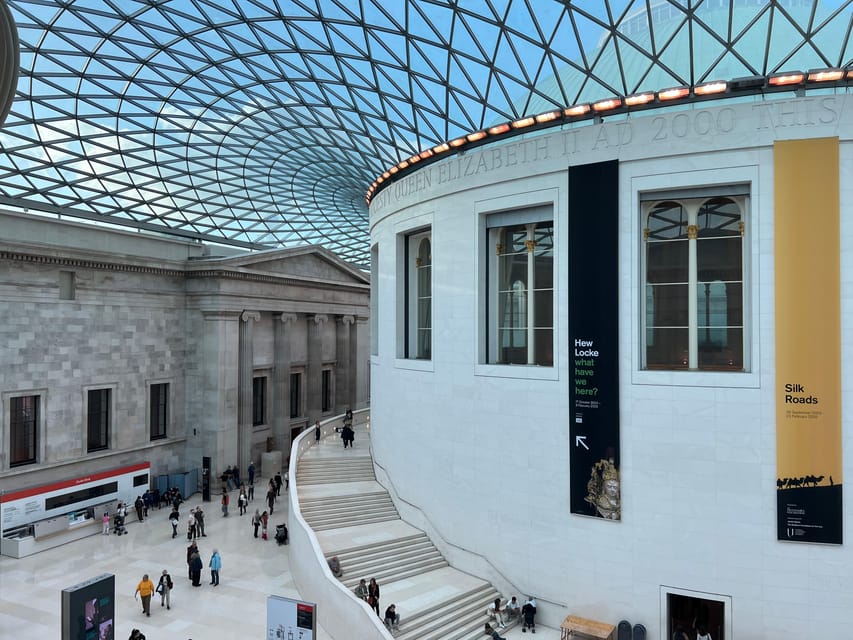
The British Museum can feel like a whole city made of stone, glass, labels, and galleries. A first visit often leaves you wondering where to begin. This private tour solves that problem by giving you a clear path through famous objects and the stories behind them.
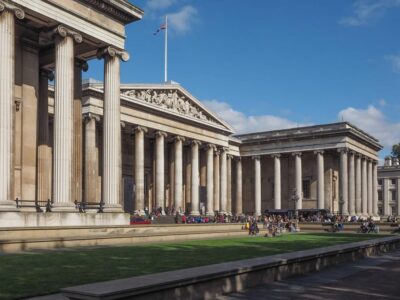
You meet at the back of the museum on Montague Place. The guide carries a white flag with the Sir London logo, so that detail matters when you are standing outside trying to spot the right person. From there, the guided visit lasts 2.5 hours.
I would plan to arrive with enough time to find Montague Place and settle in before the starting time. Transportation, food, and beverages are not included, so handle those separately. Weapons and sharp objects are not allowed.
The tour is designed for a private group of no more than five people. That makes a difference in a museum. You are not trying to keep up with a large crowd, and you have a better chance to ask why an object matters rather than simply hearing its name and moving on.
More British Museum visits:
- London: British Museum Guided Tour
★ 4.3 · 1,182 reviews - London: Tour of the British Museum
★ 4.1 · 678 reviews - London: British Museum Audio Tour & Priority Entrance Ticket
★ 4.5 · 631 reviews
Starting in the Hall of Enlightenment
The tour begins in the Hall of Enlightenment, a fitting place to set the scene. This space reflects the 18th-century interest in collecting objects from around the world and using them to understand human societies.
That opening gives the museum a useful frame. You are not simply looking at old stones, statues, and burial objects. You are also seeing how people in the modern era tried to organize knowledge about distant cultures.
I like this beginning because it gives the rest of the tour a purpose. The British Museum is famous for individual objects, but the larger idea is how humans preserve, compare, and interpret the past. A guide can make that connection in a way that a wall label usually cannot.
The possible drawback is that this introduction takes time away from the objects everyone came to see. If you want only photographs of major treasures, the opening may feel slow. If you want context, it is a sensible start.
The Rosetta Stone and the breakthrough in Egyptian writing
The Rosetta Stone is one of the essential stops. Its importance comes from the same message being written in three scripts: hieroglyphic, demotic, and ancient Greek.
That combination gave scholars a way to compare an understood language with Egyptian writing. The stone did not tell one single story about a pharaoh or battle. Its importance was practical. It helped people begin reading a written system that had been out of reach for centuries.
Your guide can help you look beyond the stone’s fame and focus on the act of comparison. The markings are the point, but the larger lesson is how one surviving object changed the study of ancient Egypt.
This is also a stop where the audio system earns its keep. The explanation is more useful when you can hear the details clearly rather than catching only fragments while other museum sounds compete for your attention.
Egyptian false doors and the idea of the afterlife
The Egyptian false doors offer a quieter but more unusual part of the route. These carved features were placed in tombs and represented a passage between the world of the living and the world of the dead.
They were not ordinary doors meant to open into another room. Their symbolic role was tied to communication, offerings, and the movement of the soul into the afterlife. A guide can help you read the doorway as part of a belief system rather than as a decorative object.
I find this kind of stop valuable because it shows how ancient Egyptian religion appeared in everyday burial practices. The Rosetta Stone is famous for its effect on modern scholarship. The false doors are valuable for what they reveal about the people who commissioned and used them.
More Museum Tours in London:
- London: Chelsea Football Club Stadium and Museum Tour
★ 4.8 · 4,576 reviews - London Transport Museum Entrance Ticket
★ 4.5 · 1,323 reviews - London: Jack the Ripper Museum Tickets
★ 4.2 · 894 reviews - Afternoon Tea at the British Museum
★ 4.2 · 511 reviews
The Colossus of Ramses II
The Colossus of Ramses II gives the Egyptian section a strong visual moment. Its scale communicates power before you know anything about the ruler it represents.
Large royal statues were designed to make authority physical. The statue’s size, pose, and presence helped express the status of Ramses II and the strength of the state behind him.
This is a good place to listen for the guide’s explanation of how monuments worked in ancient Egypt. The object is easy to photograph, but the better question is why it had to be so large and what message that size sent to the people who saw it.
The stop also reminds you that a museum visit is not only about small, delicate items. Monumental sculpture can tell you about government, religion, labor, and public image all at once.
The Lamassus and Assyrian royal power
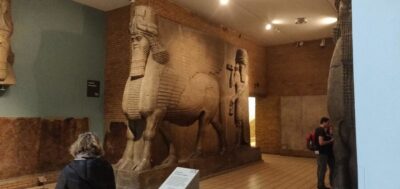
The route then moves toward Mesopotamia and the imposing Lamassus. These guardians have the body of a bull or lion and a human head. They were placed at the entrances of Assyrian palaces.
Their hybrid form is part of the point. The body suggests strength, while the human head suggests intelligence and authority. Together, the figure protected the palace and announced the power of the ruler inside.
These sculptures can be startling in person because of their size and physical presence. I would pay attention to how they were positioned and what it must have meant to approach a palace entrance guarded by such figures.
The guide’s narrative is particularly useful here because Mesopotamian objects can be harder to place than the museum’s most familiar Egyptian pieces. A short explanation turns a massive winged guardian into evidence of how Assyrian kings presented themselves.
The Lion Hunt reliefs of Ashurbanipal
The reliefs showing King Ashurbanipal hunting lions offer some of the most animated scenes on the route. The carvings capture the movement and danger of the hunt, but they also serve a political purpose.
Royal lion hunts symbolized control. The king was shown facing a powerful animal and defeating a threat, reinforcing the idea that he could protect the kingdom and command nature.
Look closely at the details rather than taking in the relief as one busy scene. The animals, weapons, horses, and gestures work together to create tension. The images are carefully arranged, but they are not lifeless. You can see the drama the artists wanted the viewer to feel.
This is a strong stop for anyone who likes art with a clear narrative. It is also a useful reminder that ancient palace decoration often served as royal messaging, not just decoration.
The Parthenon Marbles and a continuing debate
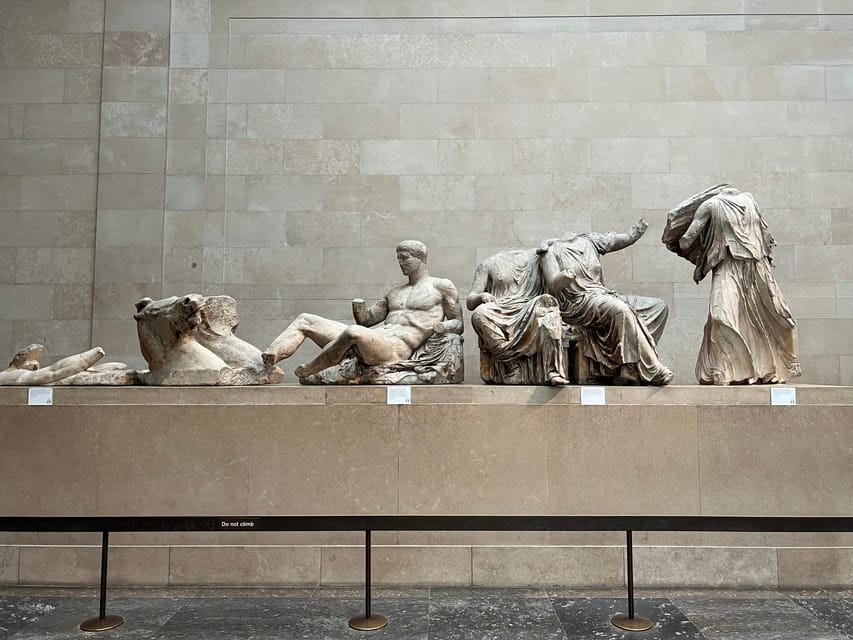
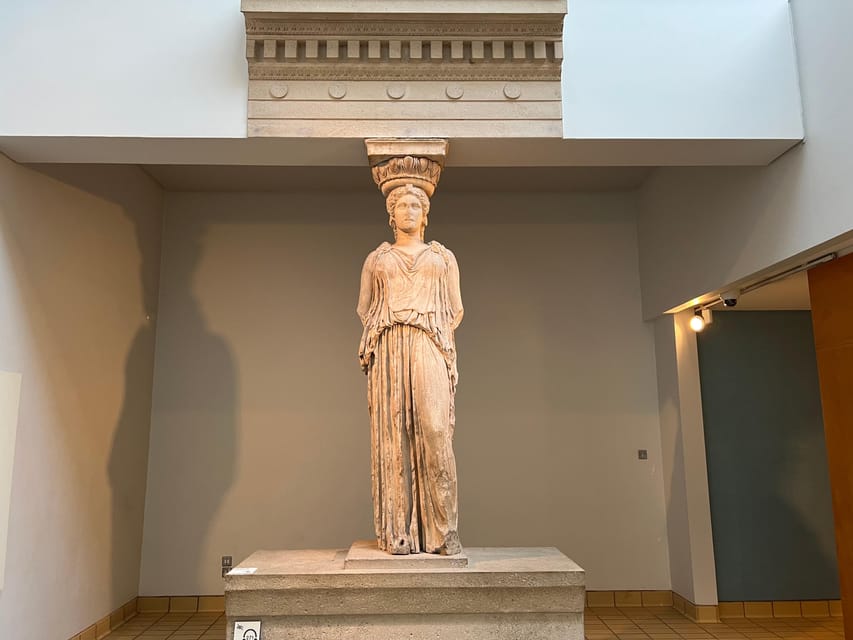
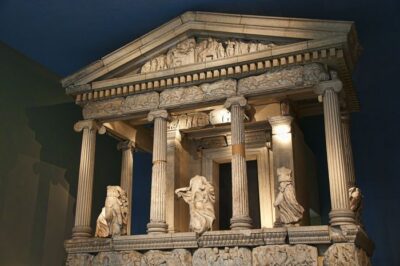
The Parthenon Marbles bring the tour into classical Greece. The sculptures and friezes once formed part of the Parthenon in Athens, where mythological scenes and figures helped express the importance of the city and its gods.
You can study the carving, the human forms, and the way the figures were arranged as part of a larger architectural program. The objects make more sense when you remember that they were created for a temple, not as separate gallery pieces.
This is also the point where the museum’s collection connects to a major modern debate about ownership and cultural heritage. The provided tour details focus on the art and its role in ancient Greece, but you may want to ask the guide about the marbles’ contested place in London and Athens.
That discussion is one reason a private tour can be worthwhile. You can ask a direct question and hear the explanation in context. The limitation is that a 2.5-hour visit cannot fully cover every part of the debate, so treat this as an introduction.
Egyptian mummies and the practical side of burial
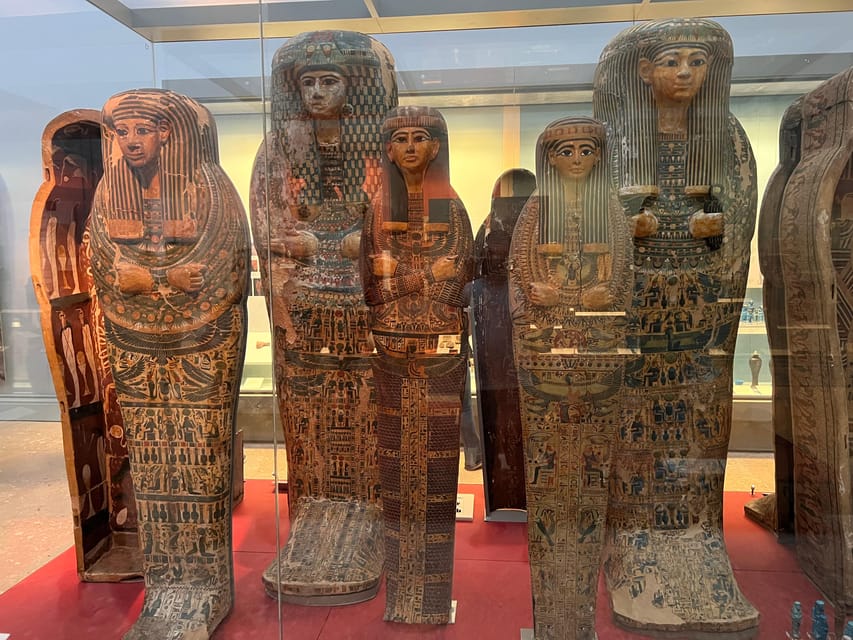
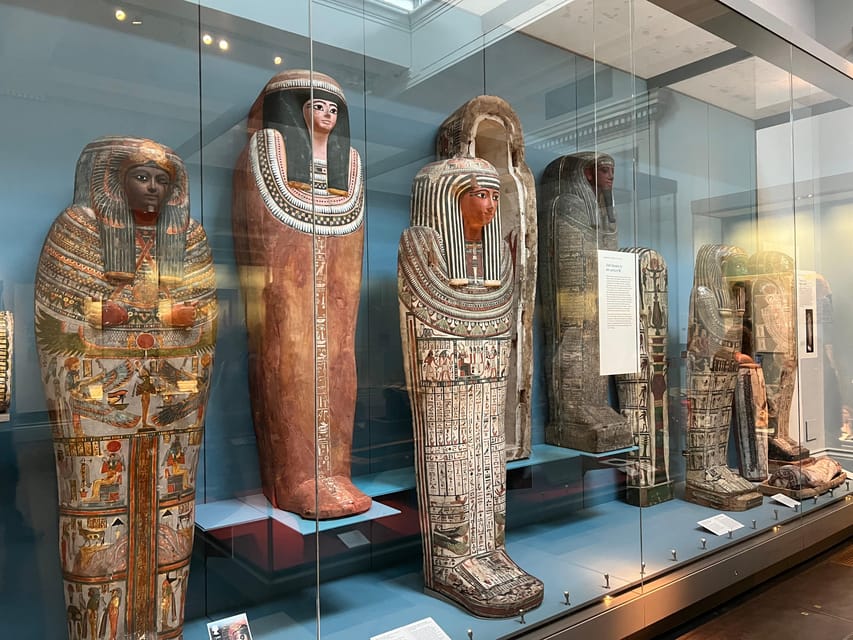
The Mummy Gallery is likely to be one of the most memorable sections. It shows how ancient Egyptians worked to preserve the dead and prepare them for existence after death.
Mummification is often reduced to a dramatic image, but the displays connect physical preservation with religious belief, ritual, and social custom. The guide can help explain why the body mattered and how the burial process fit into a wider view of the afterlife.
For some people, this will be the most fascinating stop. For others, human remains can feel unsettling. The experience does not present only polished sculpture and royal monuments. It asks you to confront the physical reality of ancient burial practices.
I would pay attention to how the objects around the mummies add information. A mummy alone can seem mysterious. Burial equipment and explanation help turn that mystery into a clearer picture of Egyptian life and death.
Sutton Hoo and Anglo-Saxon England
The tour later shifts to medieval England with the Sutton Hoo Treasure. This burial included jewelry, weapons, ritual objects, and the famous ceremonial helmet associated with an Anglo-Saxon king.
Sutton Hoo matters because it shows that early English society was connected, skilled, and visually sophisticated. The objects reveal status, craft, ceremony, and links between warfare and kingship.
After the scale of Egypt, Assyria, and Greece, this section changes the mood. You are no longer looking only at ancient Mediterranean or Near Eastern civilizations. You are seeing a powerful burial from England itself.
I like this inclusion because it prevents the tour from treating British history as an afterthought. The Sutton Hoo objects give the visit a local connection while still fitting the wider theme of how societies expressed power through burial goods.
Lewis Chess and the final stop
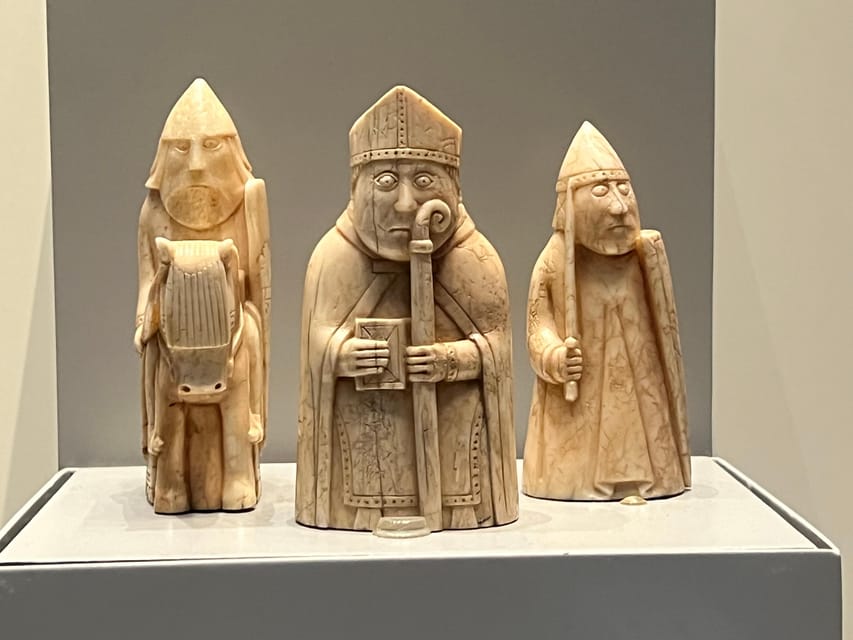
The tour ends with the Lewis Chess pieces, carved from walrus ivory and dating from the 12th century. Their faces and poses give them an unusual personality, making them easy to remember.
The set is more than a medieval game. It tells you about craftsmanship, materials, leisure, trade, and social order. A chess piece can represent a king, queen, bishop, knight, or other role, so the full set becomes a small model of medieval society.
Ending here is a clever change of scale. The tour moves from huge statues and palace guardians to objects you could hold in your hand. The pieces are also approachable for families and anyone who wants a lighter final stop after mummies and royal hunting scenes.
How much value do you get for $501?
The price is $501 for a private group of up to five people. If you fill the group, that works out to about $100.20 per person. For two people, the cost is about $250.50 each, and for one person it is a significant expense.
That pricing makes the group size important. Families, two couples, or a small group of friends can share the cost while keeping the guide’s attention to themselves. The value is weaker if you are traveling alone and mainly want to wander at your own pace.
You are paying for selection and explanation, not simply entry into a museum. The route covers famous objects across several cultures, and the guide connects them through themes of power, belief, writing, burial, and art. The audio system adds practical value because you can hear the explanation without being distracted by indoor noise.
Paid museum exhibits are not included, and food, drinks, and transportation are also outside the price. Check exactly what your booking covers before you pay, especially if a particular exhibit matters to you.
Languages, accessibility, and cancellation
Live guiding is available in English and Spanish. That is useful for a subject full of unfamiliar names and technical terms. Some content is shown in its original language, so do not expect every inscription or object label to be translated.
The experience is wheelchair accessible. If access is important for your group, confirm the specific route and meeting arrangements when booking, since the tour takes place inside a large museum.
You can cancel up to 24 hours in advance for a full refund. The reserve-now, pay-later option also helps if your London plans are still changing. Starting times vary, so you need to check availability for your chosen date.
Who will get the most from this tour?
I would recommend it most strongly to first-time British Museum visitors who want a clear introduction rather than several hours of unplanned wandering. It also suits families, small groups, and anyone who prefers asking questions in a private setting.
The tour works well for people interested in archaeology, ancient religion, royal power, and the way objects carry stories across time. The mix of Egyptian, Mesopotamian, Greek, Anglo-Saxon, and medieval material gives you a broad view in one morning or afternoon.
It may not suit you if you already know the museum well, want to focus on one culture, or prefer reading labels alone. The route is selective by necessity. You will see important highlights, but you will not cover every gallery.
The two five-star bookings offer one useful detail about the guiding. Carlos from Mexico and Caroline from Brazil both singled out Andrés and his explanations. That praise makes the guide’s role worth considering when you compare this tour with a self-guided visit.
Should you book the British Museum private tour?
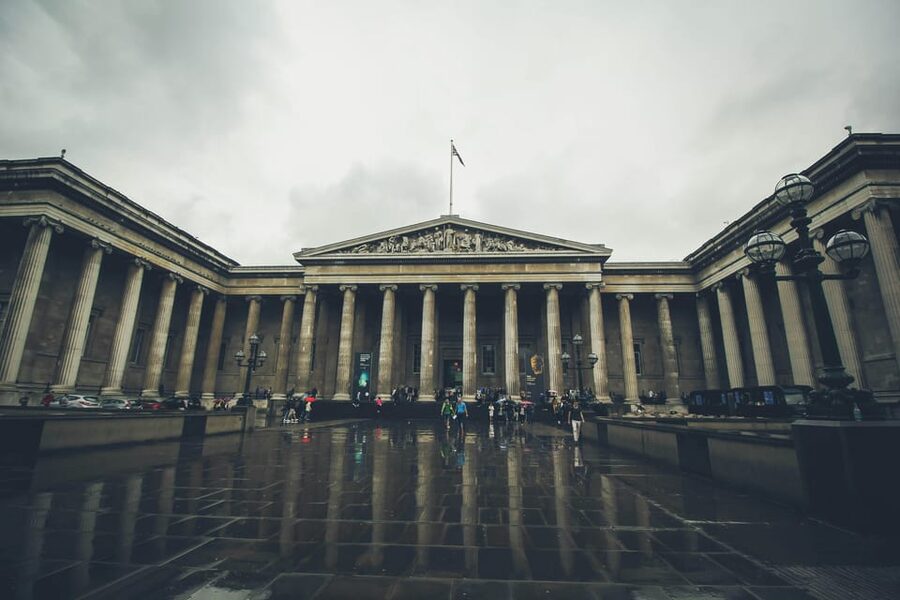
Book it if you have a small group, want a live guide in English or Spanish, and value a strong route through the museum’s headline objects. The Rosetta Stone, Parthenon Marbles, mummies, Lamassus, Sutton Hoo Treasure, and Lewis Chess give you an impressive range in 2.5 hours.
I would skip it if you are alone, highly budget-conscious, or happy to explore without a set route. At $501, the tour makes the most financial sense when four or five people share it.
For the best fit, arrive at the Montague Place meeting point prepared to listen, ask questions, and accept that this is a highlights tour. You will leave with a better sense of how writing, burial, kingship, religion, and art shaped the cultures represented inside the British Museum.
FAQ
How long is the British Museum private tour?
The guided tour lasts 2.5 hours.
Where does the tour meet?
You meet at the back entrance of the British Museum on Montague Place.
How will I recognize the guide?
The guide will carry a white flag with the Sir London logo.
What languages are available?
The live guide is available in English and Spanish.
Is the tour private?
Yes. It is a private group experience for up to five people.
Is the tour wheelchair accessible?
Yes, the activity is listed as wheelchair accessible.
Is an audio system provided?
Yes. An audio system is included so you can follow the explanations without being distracted by noise inside the museum.
Are paid museum exhibits included?
No. Paid museum exhibits are not included in the tour price.
Can I cancel for a full refund?
Yes. You can cancel up to 24 hours in advance for a full refund.
Just added in London
- The Best of British Cooking Class & Dining Experience★ 5.0 · 1 review
- London: Live Comedy Show at Big Belly Bar and Comedy Club★ 4.5 · 80 reviews
- London: British Museum Highlights Guided Small Group Tour★ 4.9 · 113 reviews
- The Beatles London Walking Tour★ 4.2 · 147 reviews
- The Best Highlights of London Walking Tour & Boat Cruise★ 5.0 · 1 review
- The Authentic Walking Tour with Indian Tasting Meal★ 4.8 · 4 reviews
- Iconic London: Bard, Beatles, Bond & Baker Street★ 4.9 · 15 reviews
- London: Tate Britain Official Discovery Tour★ 4.7 · 7 reviews
British Museum Tours, compared.
British Museum Audio Tour & Priority Entrance Ticket
Read our review →
British Museum Archaeology Course and Guided Tour
Read our review →
British Museum Highlights Guided Small Group Tour
Read our review →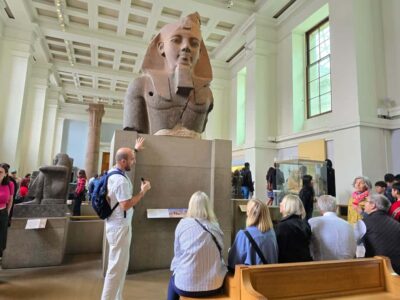
British Museum Guided Tour with Priority Entrance
Read our review →Other lists this tour turns up in