
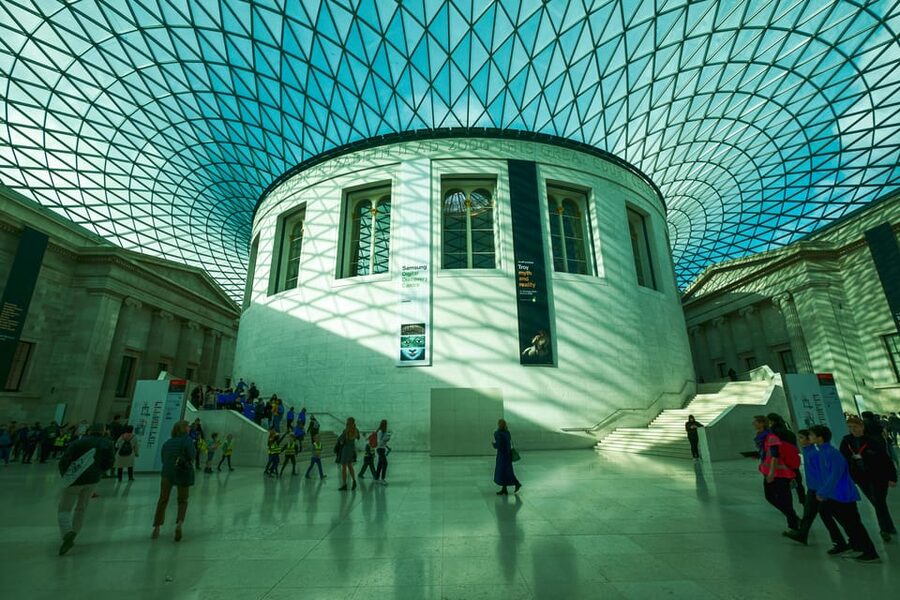
REVIEW · BRITISH MUSEUM TOURS
London: 2-Hour Guided Tour of the British Museum and History
Ancient stories come alive quickly here. This two-hour British Museum tour gives you a guided route through famous objects from Egypt, Greece, Rome, Anglo-Saxon England, and far beyond. I like the way it turns a huge museum into a manageable first visit, and the chance to see highlights such as the Rosetta Stone, Parthenon sculptures, Sutton Hoo treasures, and an Easter Island Moai. The main concern is that crowded galleries and uneven guide audio can affect how much you hear.
I also like the flexible booking terms, with cancellation up to 24 hours before the tour and the option to reserve now and pay later. Guides speak English, French, or Italian, and recent praise has singled out Daniel for his smooth handling of crowds and Filomena for her lively anecdotes and obvious passion for history.
At $37 per person, this is fair value if you want direction and context rather than simply wandering from case to case. Still, two hours passes quickly, and the quality of your visit depends heavily on the guide’s pace, language clarity, and ability to hold your group together in busy rooms.
In This Review
- Key points to know before booking
- Why two hours can work at the British Museum
- Egypt begins with the Rosetta Stone
- Greek sculpture and the Elgin Marbles
- Roman power in statues and mosaics
- Sutton Hoo and early English life
- Hoa Hakananai’a and a distant culture
- A quick trip across world cultures
- Guide quality matters more than usual
- Meeting point, tickets, and timing
- Is $37 a fair price?
- Who will enjoy this museum tour?
- Should you book it?
- FAQ
- How long is the British Museum guided tour?
- What languages are available?
- Is museum entry included?
- Where do I meet the guide?
- How do I receive my entry ticket?
- Is the museum wheelchair accessible?
Key points to know before booking
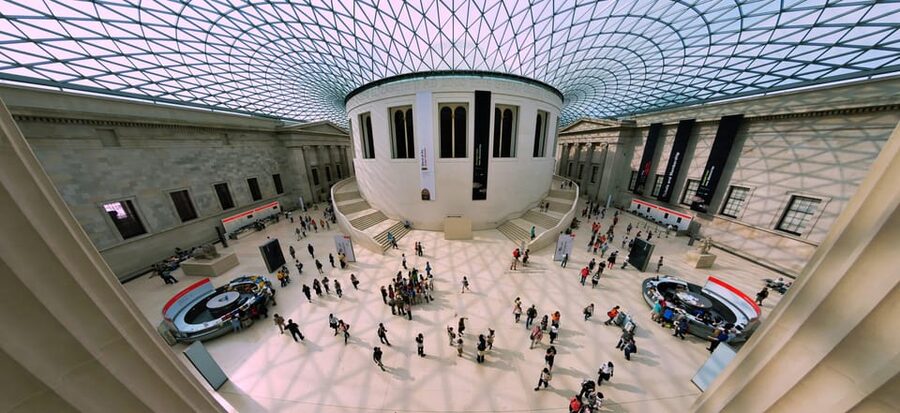
- You see major civilizations in two hours: The route links Egypt, Greece, Rome, Sutton Hoo, Easter Island, and other world cultures.
- The Rosetta Stone anchors the Egyptian section: You learn how the stone helped scholars read Egyptian hieroglyphics.
- The Parthenon sculptures come with a difficult history: The tour introduces the art and the continuing debate over the Elgin Marbles.
- A guide saves time in a vast museum: You get a planned introduction instead of trying to choose from thousands of objects.
- Crowds can affect the experience: One recent poor account focused on difficulty hearing the guide in busy galleries, so listening conditions matter.
- The tour works best as a first visit: Afterward, you can continue independently with a better sense of where to spend your time.
Why two hours can work at the British Museum
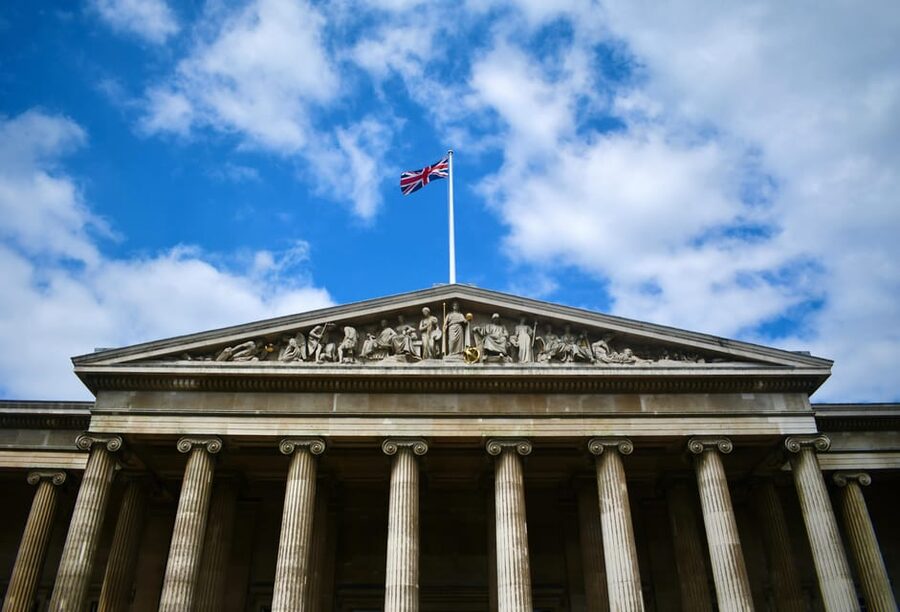
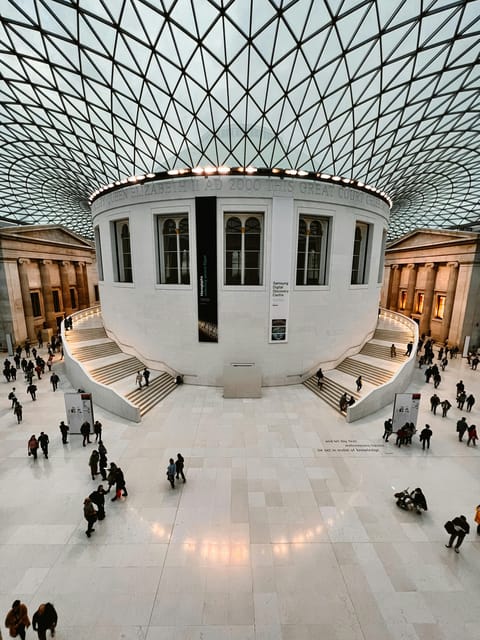
The British Museum is not a place you casually finish in an afternoon. Its collections cover human societies across continents and thousands of years, so an unguided visit can quickly turn into a march through rooms with little sense of connection.
This tour gives you a clear route and a human voice to explain why the objects matter. I see the two-hour format as an introduction, not a complete museum visit. You get the main ideas and several headline objects, then you can return to favorite galleries if your schedule allows.
The route is described as tailor-made around the museum’s most remarkable sections. That wording does not mean a private, fully customized tour, so I would not book it expecting to choose every stop yourself. It means the guide selects a practical group of major exhibits within the limited time.
That approach suits you if this is your first visit or if you have only a morning or afternoon in London. It is less suitable if you already know the museum well and want a slow study of one collection.
More History Tours in London
- London: Historic Pubs of Central London Walking Tour
★ 4.9 · 1,065 reviews - London: Soho Music and Historic Pubs Walking Tour
★ 4.9 · 836 reviews - London: Rock ‘n’ Roll History Tour
★ 4.6 · 645 reviews
Egypt begins with the Rosetta Stone
The Egyptian galleries provide a strong opening because they connect objects, writing, religion, and political power. The focus on pharaohs gives you a quick way into the civilization, while the Rosetta Stone explains one of the most important breakthroughs in the study of ancient Egypt.
The stone is famous because it carries the same decree in different scripts. Comparing those versions helped scholars work out the meaning of Egyptian hieroglyphics. That makes the object more than a famous slab behind glass. It represents the moment when a lost writing system became readable again.
You should expect the guide to spend time explaining the stone’s role rather than simply pointing it out. That context is useful because the object itself may seem less visually dramatic than a statue or gold ornament. Its importance lies in what it allowed people to understand.
One practical warning comes from a serious complaint about a guide spending more than 30 minutes on objects the group did not expect, including what the guest identified as a replica rather than the original Rosetta Stone. I cannot confirm the exact object shown during that particular tour, but the report highlights a real question: ask your guide early which pieces are original, which are casts or reproductions, and how much time remains for the main highlights.
A good guide should keep this section moving. If Egyptian writing fascinates you, you may enjoy extra explanation. If your priority is to see a broad range of famous objects, you will want the tour to avoid getting stuck in one room.
Greek sculpture and the Elgin Marbles
The Greek section brings a change in mood. Here the focus shifts toward temples, sculpture, philosophy, and the ideals that shaped later European art.
The Parthenon sculptures are among the museum’s best-known holdings. You can study carved figures and architectural details removed from the Athenian temple, while the guide explains their artistic purpose and place in ancient Greece. The tour also introduces the Elgin Marbles controversy, a subject that cannot be separated from the objects themselves.
This is an important part of the visit because the sculptures raise questions about ownership, removal, empire, and where cultural treasures should be displayed. You do not need to settle the argument before seeing them. I prefer a guide who explains the competing positions and lets you look closely at the carvings.
The itinerary also refers to marble inscriptions and the wider world of Greek thought. These details help connect art with public life, religion, and ideas. You are not just looking at attractive fragments. You are seeing pieces of a larger building and asking how they functioned in their original setting.
The drawback is time. The Parthenon material can easily absorb the full two hours by itself, especially when the group wants to examine every figure. If you want a calm, detailed look at each sculpture, plan to return after the guided portion.
Roman power in statues and mosaics
The Roman galleries offer a different kind of story. Greek art often brings ideas of temples and idealized human form, while Rome adds imperial ambition, engineering, household life, religious imagery, and a vast political system.
You can expect to see mosaics and statues showing gods, heroes, and rulers. A guide can make these objects easier to read by pointing out symbols, poses, clothing, and the way Roman artists borrowed from Greek models while adapting them for Roman purposes.
This section is especially useful for you if you enjoy connections between cultures. The Roman material does not sit apart from Greece. It shows how later societies adopted earlier styles and gave them new meanings.
Because the tour also includes Egypt, Greece, Anglo-Saxon England, Easter Island, and other regions, the Roman stop will be selective. You should expect a few important examples rather than a full survey of Roman life. That is a sensible trade for a first look, but it may leave you wanting more.
More British Museum visits:
- London: British Museum Guided Tour
★ 4.3 · 1,182 reviews - London: Tour of the British Museum
★ 4.1 · 678 reviews - London: British Museum Audio Tour & Priority Entrance Ticket
★ 4.5 · 631 reviews - Afternoon Tea at the British Museum
★ 4.2 · 511 reviews
Sutton Hoo and early English life
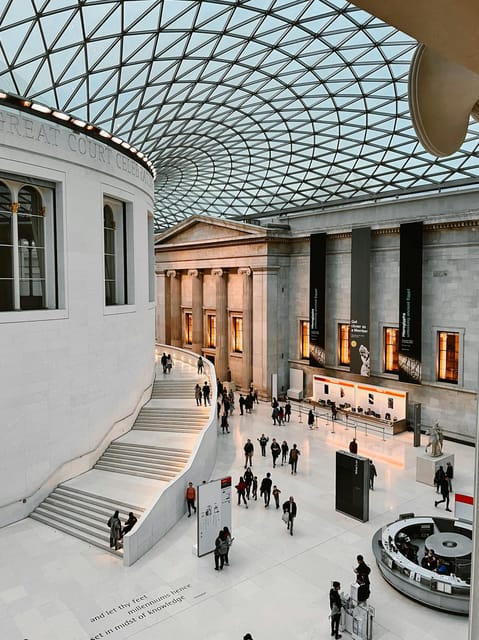
Sutton Hoo brings the story closer to England. The Anglo-Saxon treasures offer clues about early English society, status, trade, belief, and craftsmanship.
This stop matters because it breaks the usual museum route through Egypt, Greece, and Rome. The British Museum is not only about the ancient Mediterranean. Sutton Hoo shows that early English history also contains objects of great technical skill and international connection.
The treasures can help you picture a society through burial goods and decorative work rather than through long written records. You may find this part especially valuable if you want the tour to relate the museum to Britain itself.
The guide’s job here is to explain what the objects reveal and what remains uncertain. Archaeology rarely gives a complete story. A careful explanation can show how historians build conclusions from materials, while avoiding the temptation to pretend that every mystery has been solved.
Hoa Hakananai’a and a distant culture
The route then reaches Hoa Hakananai’a, a Moai from Easter Island. The figure brings a powerful change in scale and setting. Instead of a small case of objects, you confront a large stone image linked to the spiritual life of a distant Pacific culture.
This is one of the tour’s most memorable contrasts. After the formal sculpture of Greece and the political imagery of Rome, Hoa Hakananai’a asks you to think about ancestry, ceremony, community, and sacred authority.
The Moai also reminds you that the museum’s collection was built from objects taken from many parts of the world. A guide can provide useful cultural context, but you may also want to consider how such a large and important figure came to be in London rather than on Easter Island.
The itinerary promises insight into the spiritual meaning of the Moai, though the exact amount of time depends on the guide. If this object is your main reason for booking, tell the guide at the start. That may help you get enough explanation before the group moves on.
A quick trip across world cultures
The final part broadens the scope beyond the named highlights. You may see additional objects from around the globe, chosen to show how varied human societies have expressed power, faith, art, technology, and daily life.
This wider view is one of the tour’s strongest ideas. Instead of treating Egypt, Greece, Rome, England, and Easter Island as isolated chapters, the museum can show you different answers to familiar human questions. How do people honor the dead? How do rulers present themselves? How do communities record belief? How do artists make meaning from stone, metal, clay, or paint?
You will not have enough time to understand every culture in detail. That is not a flaw so much as a limit of the format. Think of the final section as a set of signposts for a later independent visit.
I recommend noting down the names of rooms or objects you want to revisit. The guide may cover them too quickly for close study, but the introduction can help you decide what deserves another hour.
Guide quality matters more than usual
A two-hour museum tour depends strongly on communication. Recent experiences have praised Daniel for explaining the collection in a free-flowing way while navigating crowds, and Filomena for sharing unusual anecdotes and bringing visible enthusiasm to the subject. Those comments point to the best version of this tour: a guide who keeps moving, chooses well, and makes connections without turning the visit into a lecture.
There is also a clear warning. One dissatisfied participant found an Italian-accented English explanation difficult to follow and said the crowded rooms made the problem worse. The same account said no headphones were provided, and several members of the group left early.
That does not mean every tour has an audio problem. It does mean you should arrive ready to speak up. If you cannot hear, tell the guide immediately rather than waiting half an hour. Stand close when possible, and ask for key points to be repeated.
Language options are English, French, and Italian. If you are booking in English but listening is a concern, confirm the language at the meeting point and stay near the guide. The museum’s size and public setting make clear speech and group management essential.
Meeting point, tickets, and timing
You meet the guide in front of the British Museum portals, on the stairs near the pillars, after passing the security check. Do not wait outside the gates. That instruction is easy to miss and could cause a stressful start in a busy central London location.
Your entry tickets are sent by WhatsApp one to two hours before the tour. If you do not use WhatsApp, contact the provider by email so the tickets can be sent another way. Check your messages before setting out, and allow enough time to pass security and reach the stated meeting place.
The duration is two hours, with starting times depending on availability. Since the tour begins inside the museum after security, last-minute arrival could be awkward. I would arrive early enough to handle the entrance without rushing.
Entry is included in the activity information, and the museum is wheelchair accessible. The listing also contains a contradictory note saying an entry ticket is not included, so I would confirm the ticket arrangement at booking. The separate meeting instructions clearly state that tickets will be provided before the tour.
Is $37 a fair price?
At $37 per person, the value comes from the guide, not from the museum admission alone. The British Museum is a public museum, so you are paying for a planned route, interpretation, and the time saved by not having to make your own choices in a vast collection.
I think the price is reasonable for a first visit, particularly if you have only two hours and want the famous sections explained. A good guide can help you understand why the Rosetta Stone matters, place the Parthenon sculptures in context, and connect Sutton Hoo and Hoa Hakananai’a to the wider story of human culture.
The value is weaker if you prefer reading labels at your own speed or if you already know exactly which galleries you want. In that case, a self-guided visit may give you more control.
Free cancellation up to 24 hours before the start gives you some protection if your London plans change. The reserve-now, pay-later option also helps if you are still arranging your schedule.
Who will enjoy this museum tour?
I would recommend it most strongly to:
- First-time British Museum visitors who want a clear starting point
- Families with school-age children who benefit from stories and connections
- Adults who prefer explanation to reading hundreds of labels
- Short-stay visitors who need a focused introduction
- People interested in comparing cultures rather than studying one collection
The tour can work for children, although the two-hour pace and subject matter may be demanding for very young ones. The positive note about Filomena specifically recommends her for families with school-age children, but guide style can vary.
You may want a different plan if you need guaranteed quiet, detailed study of one civilization, or complete control over the route. Crowds are part of the setting, and the museum’s public galleries do not offer the controlled conditions of a private viewing.
Should you book it?
Book this tour if you want a guided first look at the British Museum’s biggest subjects and you value context, route planning, and a human explanation. The combination of Egypt, Greece, Rome, Sutton Hoo, and Hoa Hakananai’a gives you a broad introduction in a short time.
I would treat it as your orientation, not your whole museum day. Stay alert to the guide’s audio, ask questions early, and return independently to the objects that catch your interest. If you do that, $37 can buy a useful foundation for understanding one of London’s most demanding museums.
FAQ
How long is the British Museum guided tour?
The tour lasts two hours. Starting times vary, so you need to check availability when booking.
What languages are available?
The live guide option is available in English, French, and Italian.
Is museum entry included?
The activity information says entry tickets are included and that tickets are sent one to two hours before the tour. A separate note contains conflicting wording about entry, so confirm this when booking.
Where do I meet the guide?
Meet in front of the British Museum portals on the stairs near the pillars, after passing through security. Do not wait outside the gates.
How do I receive my entry ticket?
Tickets are sent through WhatsApp one to two hours before the tour. If you do not have WhatsApp, contact the provider by email to request the tickets there.
Is the museum wheelchair accessible?
Yes. The provided information states that the museum is wheelchair accessible.
More Museum Tours in London
- London: Chelsea Football Club Stadium and Museum Tour
★ 4.8 · 4,576 reviews - London Transport Museum Entrance Ticket
★ 4.5 · 1,323 reviews - London: Jack the Ripper Museum Tickets
★ 4.2 · 894 reviews - London: Paradox Museum Entry Ticket
★ 3.9 · 441 reviews
Just added in London
- The Best of British Cooking Class & Dining Experience★ 5.0 · 1 review
- London: Live Comedy Show at Big Belly Bar and Comedy Club★ 4.5 · 80 reviews
- London: British Museum Highlights Guided Small Group Tour★ 4.9 · 113 reviews
- The Beatles London Walking Tour★ 4.2 · 147 reviews
- The Best Highlights of London Walking Tour & Boat Cruise★ 5.0 · 1 review
- The Authentic Walking Tour with Indian Tasting Meal★ 4.8 · 4 reviews
- Iconic London: Bard, Beatles, Bond & Baker Street★ 4.9 · 15 reviews
- London: Tate Britain Official Discovery Tour★ 4.7 · 7 reviews
British Museum Tours, compared.

British Museum Audio Tour & Priority Entrance Ticket
Read our review →
British Museum Archaeology Course and Guided Tour
Read our review →
British Museum Highlights Guided Small Group Tour
Read our review →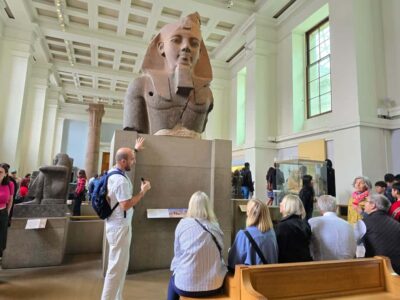
British Museum Guided Tour with Priority Entrance
Read our review →Other lists this tour turns up in